
Someone made and posted this awesome Stream-Earth. Heraclitus might approve.

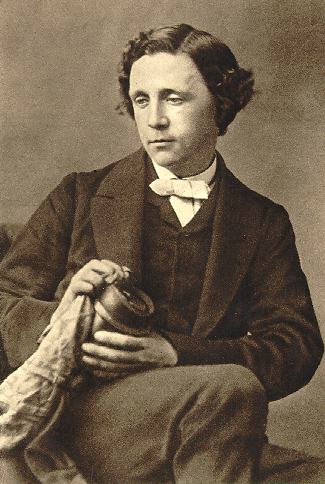 My theory is that Lewis Carroll possibly used the major lessons of Aristotle’s logic to structure his Wonderland and Through the Looking Glass, including the ten categories, the ten sorts of things that can be said about anything in Aristotle’s Categories, and four statements, the four ways something can be said about anything in Aristotle’s On Interpretation, which correspond to the four “perfect” forms of the syllogism in Aristotle’s Prior Analytics and are also known as the four corners of the Square of Opposition. The overall lesson of both books about Alice is patience over time and tolerance between positions to balance between extremes, the overall lesson of Aristotle’s ethics.
 Here is the overall shape of my theory regarding the ten categories and four statements, with more evidence for each and more about balance and ethics to follow. I am in the process of working out the evidence and details, but Carroll knew Aristotle’s work on logic well and there is much that corresponds well with both books about Alice.
If we take Aristotle’s order of the ten categories from the beginning of Aristotle’s Categories, and we reverse their order, as if seen in a mirror, starting with passion, the last, and ending with substance, the first, they correspond remarkably with the order of events of both books, chapter by chapter, together. The first chapter of each work is about passion, with the White Rabbit of Wonderland and the Black Kitten of the Looking Glass. The second chapter is about action, with the swimming Mouse and the running Red Queen. The third chapter is about state, with the Dodo’s caucus race and the Gnat on the Train. The fourth chapter is about position, with Alice taking a position in the White Rabbit’s house and between Tweedle Dum and Dee.
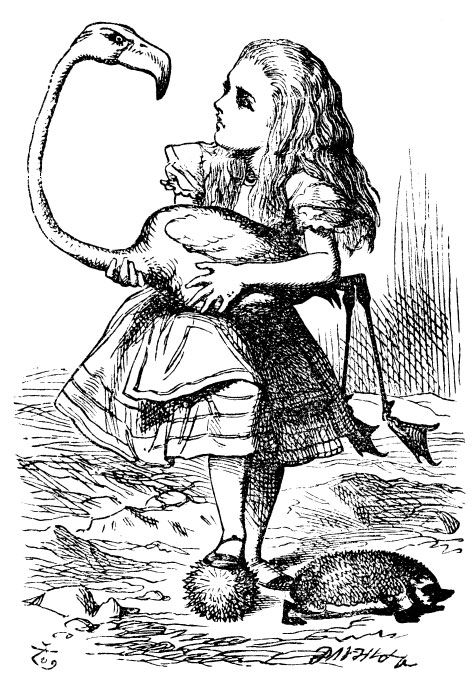 The fifth and sixth chapters of each work are about time, space and relations interwoven together, with the Caterpillar, Cheshire Cat and Duchess of Wonderland and the White Queen, Sheep and Humpty Dumpty of the Looking Glass. In each book, time comes first, the Caterpillar and White Queen, followed by relations, the Duchess and Humpty Dumpty. In Wonderland, space appears as the Cheshire Cat, who is in the house of the Duchess, though he speaks about space and position to Alice after she experiences the Duchess’ poor relations with others. In the Looking Glass, space appears as the Sheep, who is also time, the White Queen, before Alice meets Humpty Dumpty and his poor relations with her.
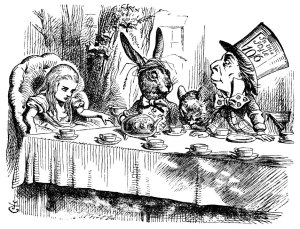 The seventh chapter of each work is about quality, with the Tea Party and the Lion & Unicorn, and the Mad Hatter and Hare appear in both. The eighth chapter is about quantity, with the playing cards of the Queen of Hearts and inventions of the White Knight. The remaining chapters of each work are about substance, with the insubstantial lies of the Mock Turtle leading to the King of Heart’s Trial over tarts, and the test about sums leading to the Queens’ Banquet.
The four royal court figures of both books, the White Rabbit, Duchess, Queen of Hearts and King of Hearts of Wonderland and the Red Queen, Red King, White Queen and White King of the Looking Glass, correspond with Aristotle’s four types of statements and four “perfect” forms of the syllogism, found in Aristotle’s On Interpretation and Prior Analytics: In Wonderland, the White Rabbit is particular and positive, accepting some and some, worried about being late for others and accepting Alice into his house as a servant, the Duchess is particular and negative, rejecting some and some-not with punishments and morals in her house, the Queen of Hearts is absolute and negative, subtracting and excluding anyone entirely for any mistake in her garden, and the King of Hearts is absolute and positive, accepting any and all testimony as equally and entirely valid for consideration in his court.
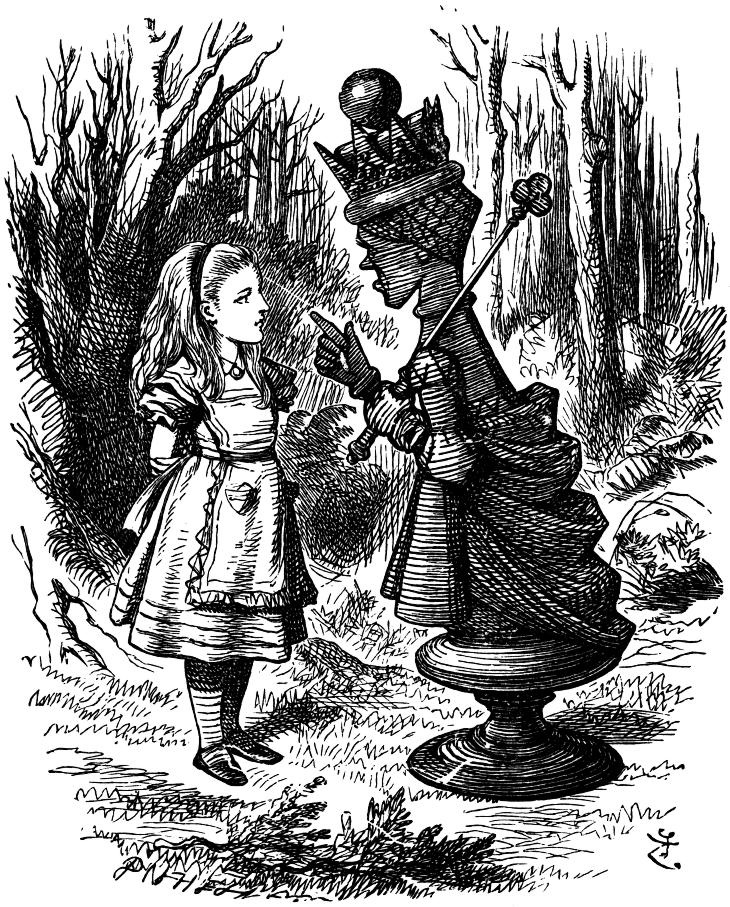 In the Looking Glass, the Red Queen is absolute and negative, like the Queen of Hearts of Wonderland, who tells Alice all ways are hers, thus none are Alice’s in her garden. The Red King is particular and negative, who dreams of Alice but in his own dream, out in the woods. The White Queen is absolute and positive, who believes impossible things before breakfast, and the White King is particular and positive, accepting the somewhat steady agreement of the battling Lion and Unicorn. In Wonderland, the royalty all rule indoor spaces, but in the Looking Glass, they are all outside in the open.
There is much that makes sense with this interpretation, and I believe it makes much sense of details that have puzzled many in the books. I got the idea by studying the text for many years in the light of Wittgenstein, Poe and others, and then a recent strong feeling that the Caterpillar stands for time led to another feeling that the Cheshire Cat stands for space, which led to looking up Aristotle’s list of the ten categories and seeing that relations, space and time are much like the Duchess, Cat and Caterpillar of Wonderland, such that Aristotle’s order seems inverted by Carroll, as if seen in a looking glass.
| Chapter | Wonderland | Looking Glass |
| 1: Passion | White Rabbit & Golden Key | Black Kitten & Looking Glass |
| 2: Action | Mouse & Pool of Tears | Flowers, Red Queen |
| 3: State | Dodo, Caucus Race | Train, Gnat, Fawn |
| 4: Position | White Rabbit’s House, Puppy | Tweedle Dum & Dee, Crow |
| 5: Time/Space | Caterpillar (Time) | White Queen (Time) & Sheep (Space) |
| 6: Relations | Duchess (Relations) Cheshire Cat (Space) | Humpty Dumpty (Relations) |
| 7: Quality | March Hare, Mad Hatter | Haigha, Hatta, Lion & Unicorn |
| 8: Quantity | Queen of Hearts, Croquet | Red Knight, White Knight |
| 9: Substance | Kind Duchess, Gryphon, Mock Turtle | Red & White Queens, Frog & Banquet |
| 10: Substance | Lobster Quadrangle | Red Queen |
| 11: Substance | King of Hearts, Trial | Black Kitten |
| 12: End | Alice & Ending | Alice & Ending |
 Lewis Carroll’s Wonderland and Through the Looking Glass are many things to many people, and they serve well as a series of amusements for children and allegories for adults, but they also serve as memorable illustrations of the basic lessons of Aristotle’s logic and ethics, as a set of absurd characters that children can remember and adults can enjoy that verbally and visually display playful engagement with serious lessons and forms, including both ancient Aristotelian and modern Boolean forms of logic that Carroll, mathematics professor and logician, knew well. Carroll owned and wrestled with the work of Aristotle, Boole, De Morgan and others as a logician in the years before and after telling Alice and her sisters his stories, and he developed a system for visually teaching forms of logic in the years after publishing his books about Alice.
If Carroll included forms of ancient and modern logic in his books about Alice, then he possibly used Aristotle’s ten categories, which Carroll knew well from the first book of Aristotle’s works on logic, to order the events and characters of Wonderland and the Looking Glass, in the order Aristotle himself listed them in the Categories, but backwards, in reverse order, as if in a looking glass or from the perspective of a child looking up to an adult, from lowest to highest, up from child of passion to adult of substance, in Wonderland from worried rabbit to king with tarts and then in Looking Glass from taunted pawn to queen of a banquet.
 If we interpret the books as illustrations of Aristotle’s ten categories, along with many other forms of ancient and modern logic, politics, ethics, philosophy, history, and mathematics that Carroll interwove throughout the books, many things in the stories correspond and make many sorts of sense. If Carroll included forms of logic in his published Wonderland and again in his Looking Glass, Aristotle’s ten categories could be the most important and central example of this, as their order can be found throughout both books and is possibly central to their structure and plot.
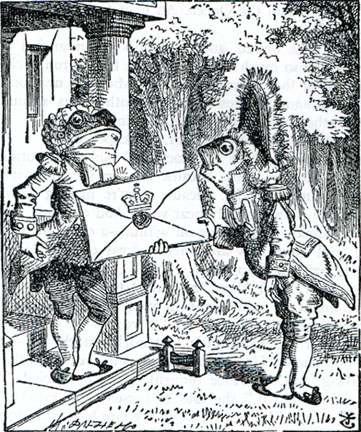 If so, in Wonderland the White Rabbit is passion, the Mouse is action, the Dodo and his Caucus Race are state, the White Rabbit’s House is position, the Caterpillar is time, the Cheshire Cat is place, the Duchess is relations, the Mad Hatter’s Tea Party is quality, the Queen of Hearts is quantity, and and the King of Hearts is substance. In the following sequel, Through the Looking Glass, corresponding chapter by chapter numerically with Wonderland, the Black Kitten is passion, the Red Queen is action, the Train is state, Tweedle Dum and Dee are position, the White Queen is time, the Sheep is place, Humpty Dumpty is relations, the Lion and Unicorn are quality, the White Knight is quantity, and the Queens’ banquet is substance. Consider how the text makes sense in light of the reverser order of Aristotle’s ten categories, first through the course of Wonderland and what this could teach Alice, and then mirrored and balanced in the sequel.
In the first chapter of Wonderland, Alice is bored, falls asleep, and dreams of the first character, the White Rabbit, who is passionate, upset and late to meet his superiors, and Alice follows him down the Rabbit Hole without a thought of how to get out, blindly following her passion. She falls down into a banquet hall, and sees a golden key on a glass table with three legs that fits a door to a beautiful garden, but she is either too big to get through the door or to small to reach the key. As a child, Alice is too passionate and extreme one way and then the other to grasp the golden key, the balance between extremes Aristotle teaches as central to his ethics, what some call the Golden Mean, which includes balance between ourselves and others, taking the smaller individual perspective of ourselves and the larger social perspective of others.
 Alice does not solve this problem now, but returns and solves it after she has spoken to Time, which the Hatter thinks Alice hasn’t. Time, the Caterpillar, teaches Alice patience, to tolerate time and change in ourselves and others, and gives Alice the mushroom after she shows him she can be patient which allows her to change and balance between the smaller and larger positions, which gets her the key, out the door and into the garden. Unfortunately, before conversing with the Caterpillar, Alice is a child who hasn’t yet learned the lesson of patience and tolerance over the course of time through discourse with others, much like the Hare and Hatter are rude and don’t plan well for the future, as Time refuses to move for them.
In the hall, following the passion of the White Rabbit, Alice cries and creates a Pool of Tears that sweeps her out of the enclosed hall and into an open ocean of emotion, which ends the first chapter. The Mouse, swimming in the pool and then away from Alice, is action, reacting to Alice’s passion for her cat, which shows she still lacks the perspective of others and balance. Alice also acts and reacts, swimming after the Mouse, blindly acting without knowing where either is going. Then she leads a multitude of animals ashore, a result of her action and leadership in a steady but stupid state, which ends the second chapter and introduces us to the Dodo.
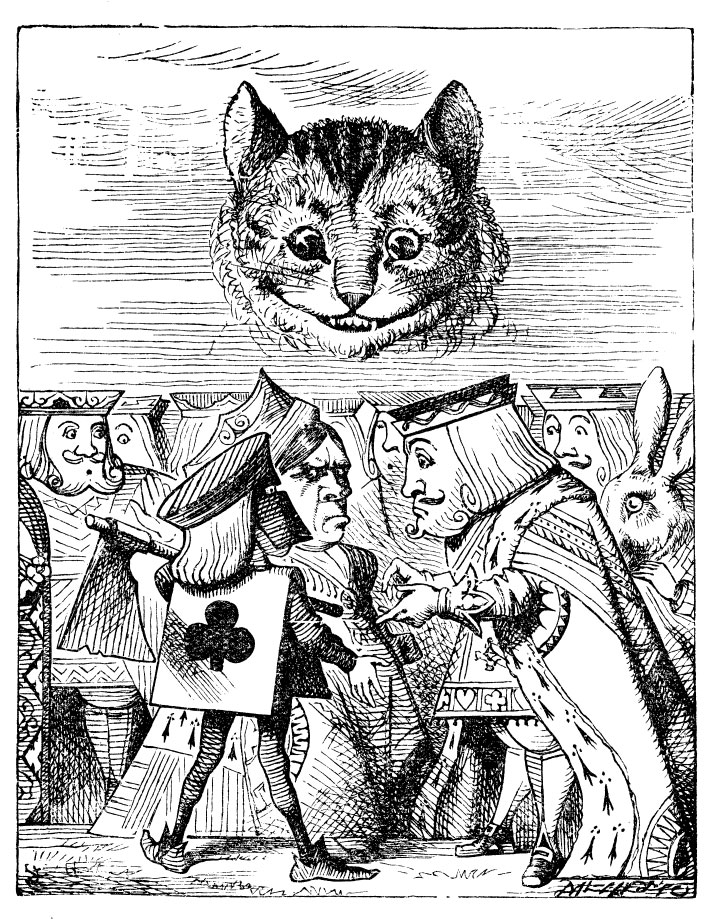
 Some have said that the White Knight of Lewis Carroll’s Through The Looking Glass is Carroll himself. If the order and characters of Wonderland and the Looking Glass fit the order of Aristotle’s ten categories, backwards, as I believe, this makes the White Knight, like the Queen of Hearts in Wonderland, quantity, and Carroll was, in his real life, a mathematics professor.
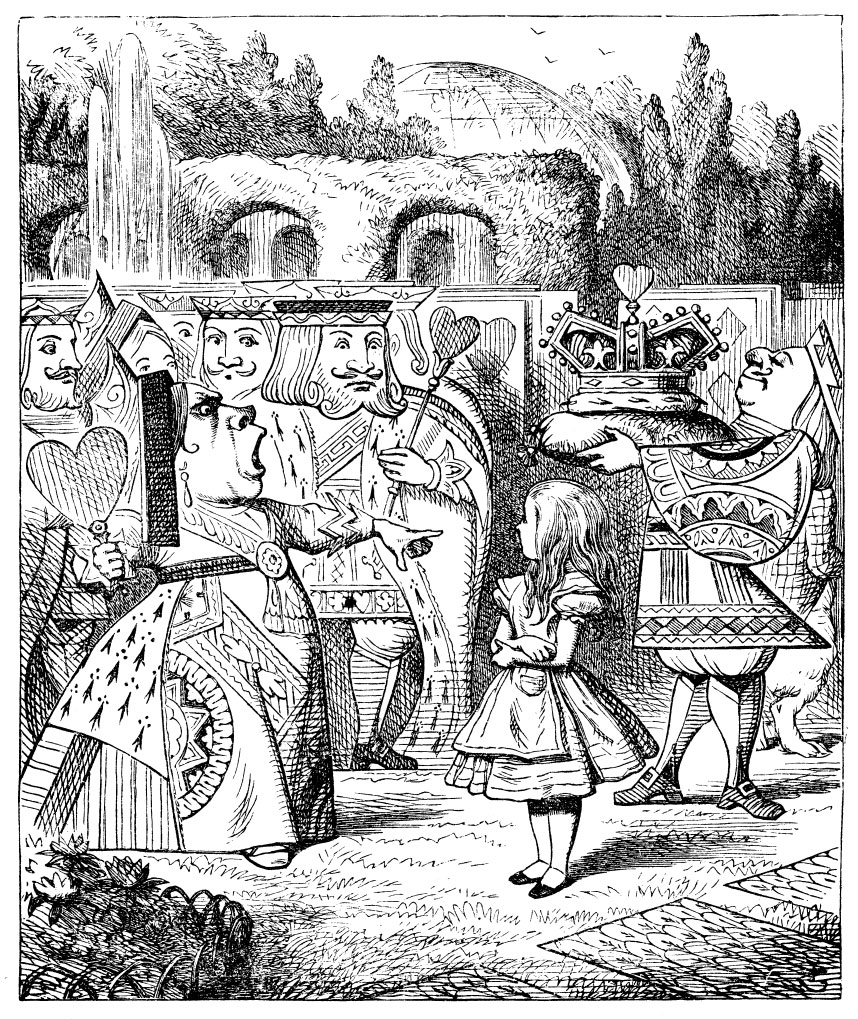 In the same way Carroll inverted several of the characters between the two books about Alice, as if in a mirror, the Queen of Hearts of Wonderland is quantity as too negative, exclusive and cruel, and the White Knight is quantity as too positive, inclusive and kind. Alice can us the overly negative and overly positive example of both to steer a middle way between them, as Aristotle (as well as Buddha, Confucius, and many others) advises in ethics. The White Knight guides Alice to the final square, where she is immediately given a test on sums, quantities, but as substances, Aristotle’s first and thus for Carroll final, category, which confuses Alice, who sits between the two positive and negative extremes.
The White Knight has a great quantity of ideas he produces, but he is a bit backwards and often upside down, much like the categories backwards. Alice has to help him turn himself around, just as Carroll likely hoped the reader would see the inverted, mirror-image forms of logic he set in both books about Alice. Aristotle would say, from the White Rabbit onward, Alice has been committing categorical errors (a fallacy found in Aristotle’s Sophistical Refutations) throughout her dreams. She confused and dreamed her desire to be like her sister, her passion, to be an absurdly formal conjunction, the White Rabbit at the beginning of Wonderland, and at the end of the Looking Glass she dreams that quantity is a Knight, and then substance is a queen’s banquet, where the people turn out to be food and the food turns out to be people.
 Thought Itself