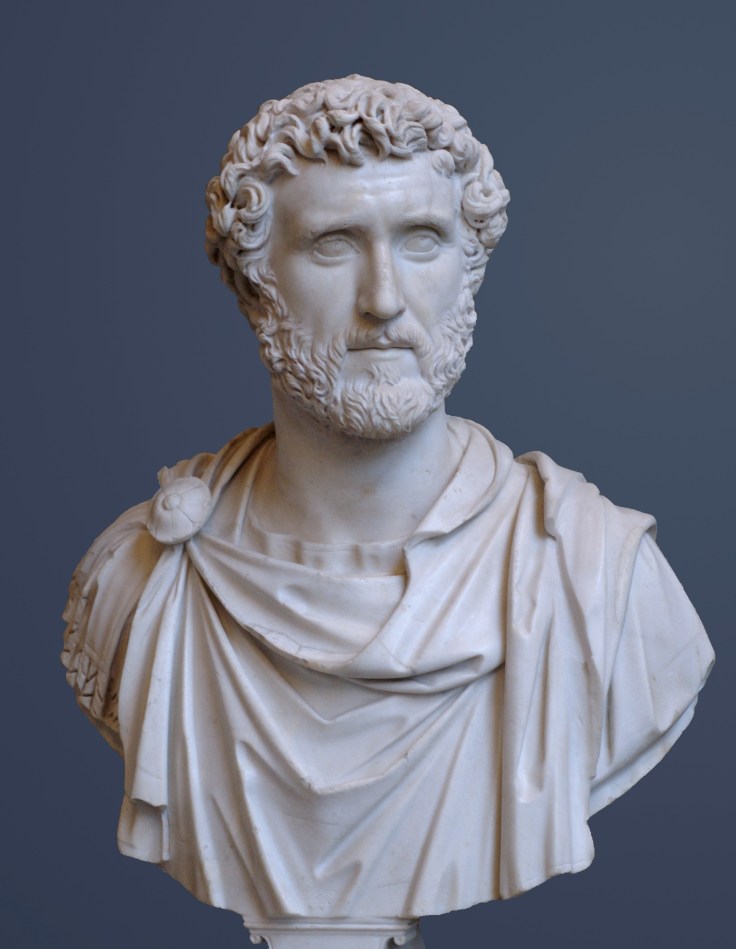
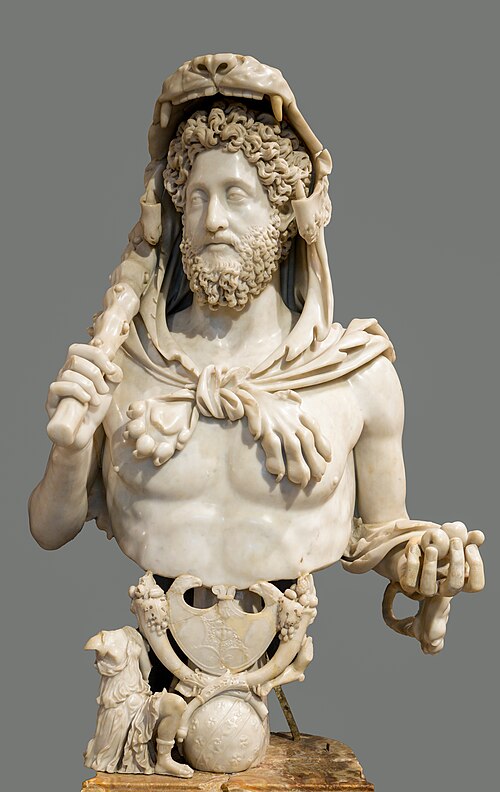
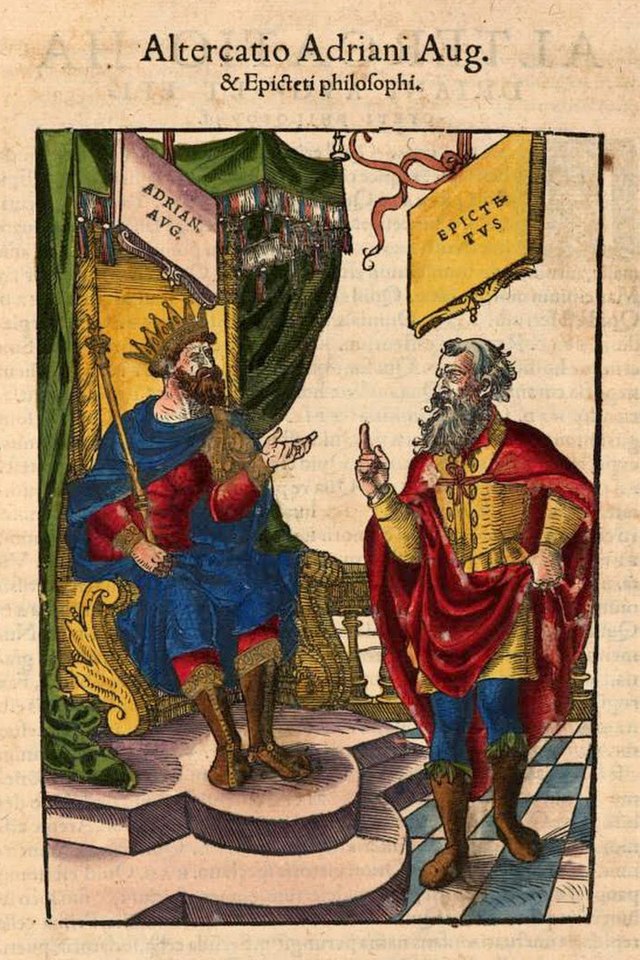
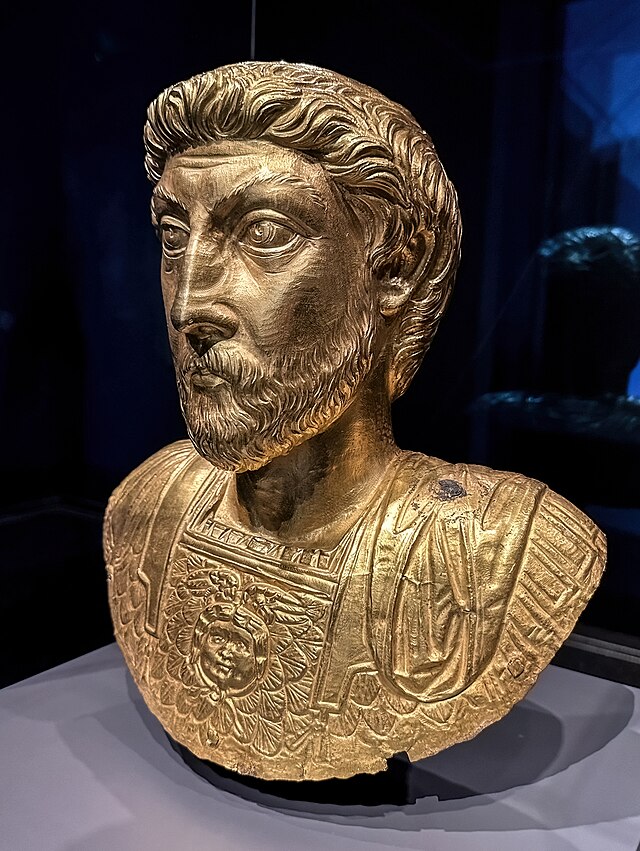
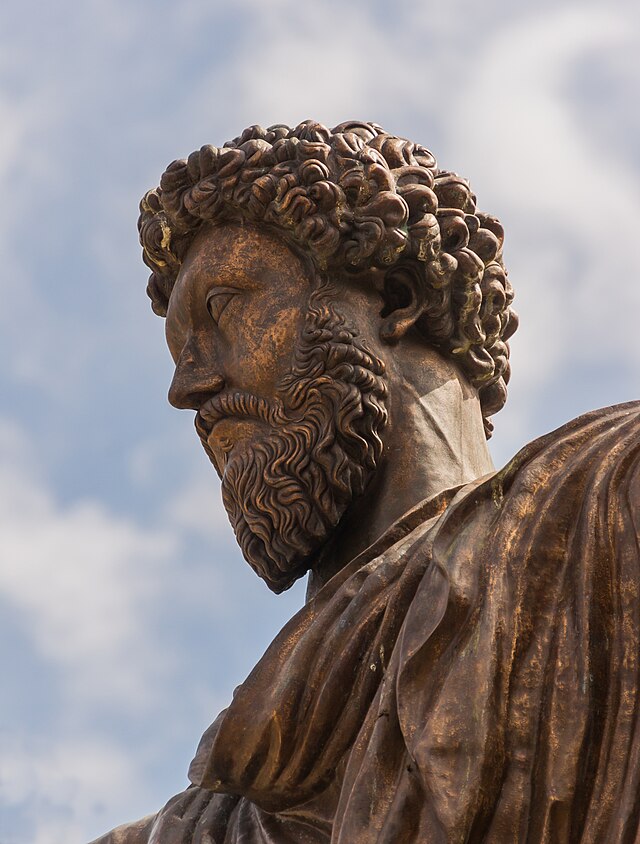
Marcus Aurelius (121-180) was born in Rome as Marcus Annius Verus into an aristocratic family of Roman Spain. Marcus’ father died when he was a child, the situation of many prominent philosophers such as Plato, Confucius, Descartes, Nietzsche and many more. He was brought up by his grandfather, a relative of the Roman emperor Hadrian, who called young Marcus Verissiumus, “Most Truthful” in Latin. Hadrian had his own adopted son Antonius Pius adopt Marcus hoping that Antonius would rule as emperor following him, and that Marcus would rule as emperor following Antonius, along with another adopted grandson, Lucius Verus. Marcus was interested in philosophy from the age of twelve, and he was educated by many famous teachers, including Fronto, who taught him about Socrates, Platonism, Aristotelianism, Epicureanism, Stoicism, logic and rhetoric. Marcus was particularly influenced by Stoicism and the Discourses of Epictetus, who died the year following Marcus’ early interest in philosophy, when Marcus would have been thirteen.
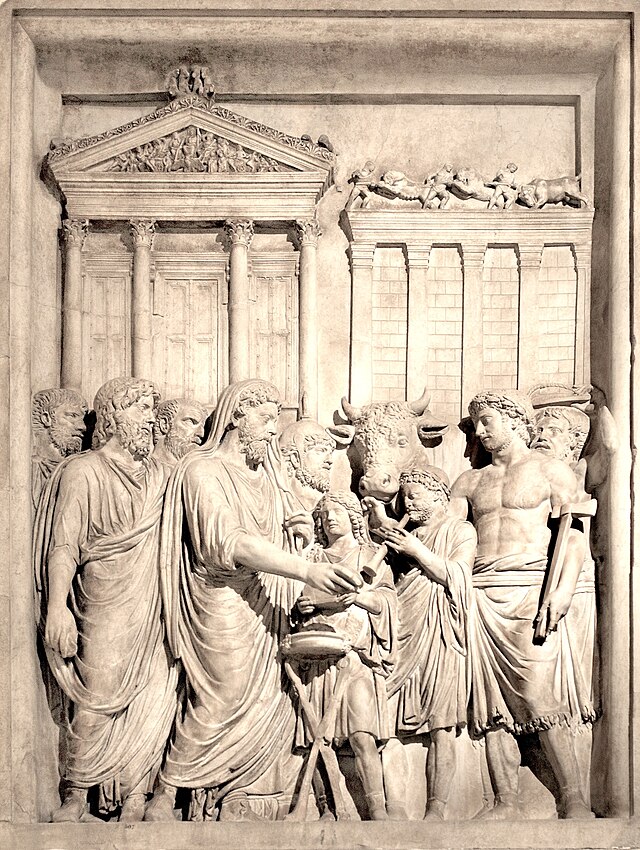
Marcus ruled as Emperor of Rome from 161-180, and brought a period of stability with the senate and prosperity in the empire, ruling together with Lucius until Lucius died from illness in 169. A supporter of philosophy, Marcus re-established teaching positions in Athens for four schools of Greek philosophy: Platonism, Aristotelianism, Epicureanism and Stoicism. Germanic tribes began invading northern Italy in 170, and Marcus waged war against them in Italy and Germany until his death. Marcus also put down a revolt in 175 by Cassius (130-175), Roman governor of Egypt and Syria who proclaimed himself emperor after hearing falsely that Marcus was on his deathbed. Unfortunately, Marcus’ son Commodus (161-192), who followed Marcus as emperor, was a poor-ruling tyrant who was assassinated.
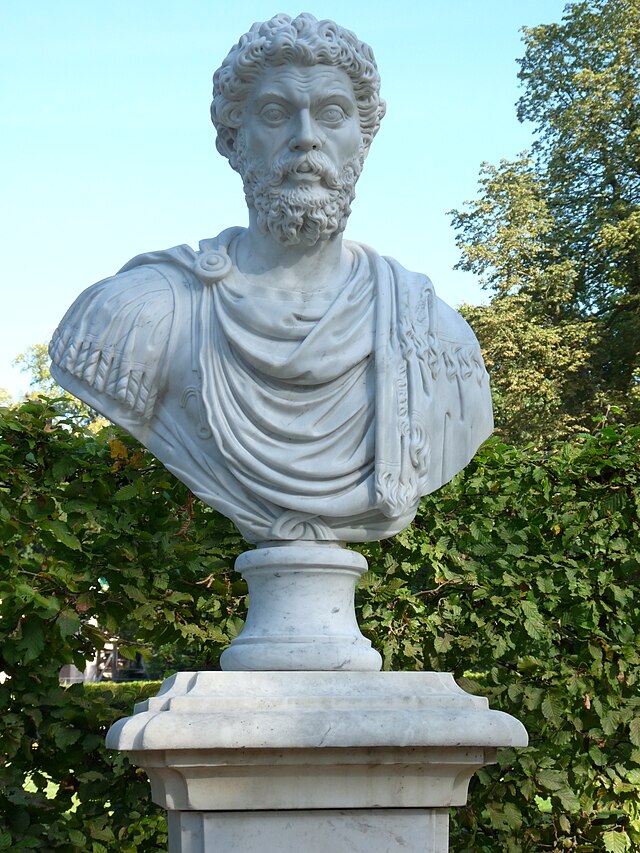
Marcus’ Meditations, now known as one of the most popular and quotable works of Stoicism, were probably written as a private journal of thoughts towards the end of his life, while he was Emperor of Rome and fighting Germanic tribes in Germany to secure the northern border of the Roman Empire. This period was captured in the epic three-hour, multimillion dollar box-office failure The Fall of the Roman Empire (1964), starring Alec Guinness as Marcus Aurelius, the original Obi-Wan Kenobi of Star Wars (1977). He is attended by his philosophical advisor Timonides throughout the film, a fictional character and former slave like Epictetus. At 17:21, Marcus tells his daughter Lucilla who is concerned for his failing health, “Death is in the order of things. Didn’t they teach you that in school?” She says she will not let him leave her, and he replies, “Is there a choice? Soon this trickle of blood, these few bones, this net woven of nerves and arteries, will be dust,” a quote from his Meditations.
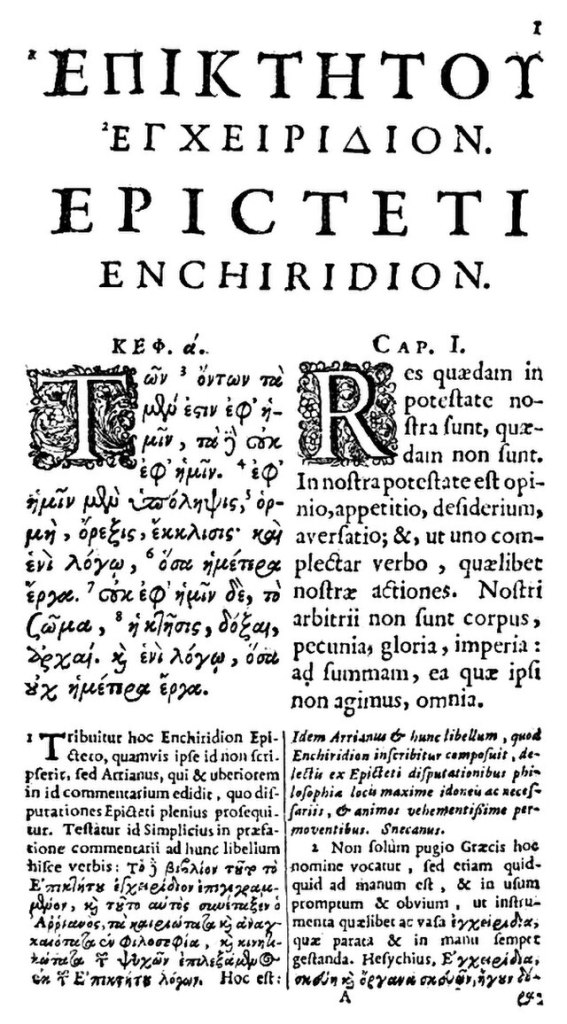
The text shows that Marcus was influenced by Stoicism and Epictetus, but also by Epicureanism, Platonism, Heraclitus, Socrates, Aristotle and other Greek philosophers popular in Roman times. Marcus does not call himself a Stoic in the text, does not mention Zeno, and repeatedly states that we may be ordained by fate with purpose or that we may be atoms clashing meaninglessly in the void, showing that he is open to the theories of Stoicism and Epicureanism. (6.10, 6.24, 7.32) He does mention Chrysippus twice, who was the most famous Stoic philosopher following the death of Epictetus. Michel Foucault (1926-1984), the later French Poststructuralist Philosopher who taught in Berkeley in 1975 and 1983, argued that Marcus’ Meditations show a turn towards concern for the individual self, much like the turn from the king-guided individual to heart-guided individual found in the middle-kingdom period of ancient Egypt. Let us turn to the many memorable, quotable phrases of the text.

When you wake up in the morning, tell yourself: The people I deal with today will be ungrateful, violent, arrogant, dishonest, jealous, and uncharitable. All of these things have come upon them through ignorance of good and evil. But I have seen the beauty of good, and the ugliness of evil, and have recognized that the wrongdoer has a nature related to my own, not of the same blood or birth, but the same mind, and possessing a share of the divine…I can neither be harmed by any of them, for no one will involve me in wrong, nor can I be angry with them or hate them, for we have come into the world to work together. (2.1)
Whatever it is that I am is flesh and a bit of breath and the ruling center… Consider too what kind of a thing breath is: a stream of air and not always the same, but at each moment. (2.2 – Note the three levels of self, via Plato and Aristotle, as well as the flux and flow of air beneath the fire at the center, which is quite Heraclitus.)
Do not engage in quail fighting or become excited over other such pursuits. (1.6)
In human life, the time of our existence is a point, our substance a flux, our senses dull, the fabric of our entire body subject to corruption, our soul ever restless, our destiny beyond divining, and our fame precarious. In a word, all that belongs to the body is a stream and flow, all that belongs to the soul, mere dream and delusion, and our life is a war, a brief stay in a foreign land, and our fame thereafter, oblivion. (2.17)
You must stand up, not be held up by others. (3.5)
Always make a sketch or plan of whatever presents itself to your mind, so as to see what sort of thing it is when stripped down to its essence, as a whole and in its separate parts. (3.11)
Do not act as if you have 10,000 years to live. (4.17)
Do not look back to examine the dark character of another, but run straight towards the finishing line, never glancing to the right or left. (4.18)
Praise means nothing to the dead. (4.19)
Strive to be simple. Someone is doing wrong? The wrong is to themselves. (4.26)
Be sober, yet relaxed. (4.26)
A stranger to the universe, who has no knowledge of what is in it… is a fugitive who flees from reason, a blind person who closes the eyes of the mind, a beggar who depends on another and does not have what they need in themselves, an abscess on the body of the Cosmos... They are a limb amputated from society, who severs their soul from the soul of all who think, which is one. (4.29)
Those who entrust themselves to the gods are neither tyrant nor slave to anyone. (4.31)
The best revenge is to be unlike the one who performed the injury. (6.6)
What should we value? That people clap when we appear? No, indeed. There is no value either in being greeted by clapping tongues. (6.16)
Alexander the Great and his stable boy were brought to the same level in death, for they were either taken back into the same generative foundation of the Cosmos or were both scattered into atoms. (6.24)
Never let the future disturb you. You will meet it, if you have to, with the same weapons of reason which today arm you against the present. (7.8)
Make sure you never feel towards the hateful as they feel for humanity. (7.65)

It is absurd not to try to escape our own evil, which is possible, but equally absurd to try to escape the evil of others, which is impossible. (7.71)
Do not merely share the air around you by breathing, but share the mind that embraces all by thinking. (8.54)
Those who are wrong wrong themselves. Those who are unjust are unjust to themselves, as they make themselves evil. (9.4)
The wrongs of others should be left with their authors. (9.20)

The cycles of the universe are always the same, up and down, from age to age. (9.28)
Fine marbles are calluses of the earth, gold and silver its pus, our clothes matted hair, and royal purple the blood of a shellfish. (9.36)
Fine marbles are calluses of the earth, gold and silver its pus, our clothes matted hair, and royal purple the blood of a shellfish. (9.36)
Live as if you are on a mountaintop. (10.15)
A good, honest person should be like one who smells like a goat. Anyone near them is immediately aware of it, whether they know it or not. (11.15)

Kindness is invincible. (11.18)
Anger is a mark of weakness on those who have been wounded and surrendered to the enemy. (11.18)
The elements of air and fire which enter into us tend to rise upwards, but they obey the order of the whole, held fast in our being. Likewise the elements of earth and water in us tend to flow downwards, but are held up and stay in position… It is strange, then, that reason is stubborn and upset with its position. (11.20)
I have often wondered how it is that every man loves himself more than all the rest of men, but yet sets less value on his own opinions of himself than on the opinions of others. (12.4)

There is one light in the Sun, but it is broken by walls, mountains, and countless other obstacles. (12.30)
The object of life is not to be on the side of the majority, but to escape finding oneself in the ranks of the insane.
How much more grievous are the consequences of anger than the causes of it.
It is not death that a man should fear, but he should fear never beginning to live.
Live every day as if it were your last. (7.69)