

In Umberto Eco’s piece on fascism for the New York Review of Books, he uses Wittgenstein’s idea of family resemblance and example of games to understand the “structured confusion” of fascism:
The notion of fascism is not unlike Wittgenstein’s notion of a game. A game can be either competitive or not, it can require some special skill or none, it can or cannot involve money. Games are different activities that display only some “family resemblance,” as Wittgenstein put it. Consider the following sequence:
1 2 3 4
abc bcd cde def

Suppose there is a series of political groups in which group one is characterized by the features abc, group two by the features bcd, and so on. Group two is similar to group one since they have two features in common; for the same reasons three is similar to two and four is similar to three. Notice that three is also similar to one (they have in common the feature c). The most curious case is presented by four, obviously similar to three and two, but with no feature in common with one. However, owing to the uninterrupted series of decreasing similarities between one and four, there remains, by a sort of illusory transitivity, a family resemblance between four and one.
This is a point that can be made about fascism, apples, cats, philosophers, or anything else in our world. I typically use apples to explain this idea of Wittgenstein, and was pleasantly surprised to find Eco using it to understand fascism, as I am teaching Wittgenstein for Intro Philosophy this week, and fascism for Social & Political Philosophy next semester.

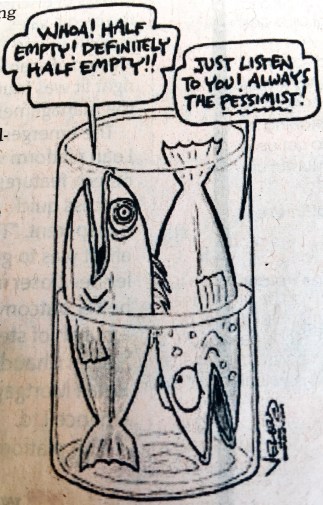

 A horse walks into a bar and orders a beer. The bartender says, “You’re in here every day. You might be an alcoholic”. The horse says, “I don’t think I am,” and disappears. It’s a joke about Descartes, but you don’t want to put him before the horse.
(An adaptation of a joke I found on the Reddits)



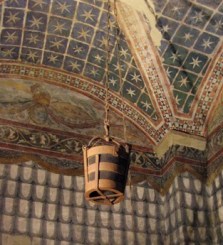 In the years before the Renaissance, Italy was divided into warring city-states, some which supported the Holy Roman Emperor, such as Modena, and some which supported the Pope, such as Bologna. In 1325, after hundreds of years of bitter fighting between the two, some Modenese soldiers slipped into Bologna and stole an oak bucket from a public well. When Bologna demanded they give it back, Modena refused, so Bologna attacked with an army of over thirty thousand. Two thousand were killed, and Modena still has the bucket today. Centuries later, the poet Tassoni wrote a mock epic about the war: La Secchia Rapita, the Stolen Bucket.
 Thought Itself