Stanford Study on Walking and Creativity
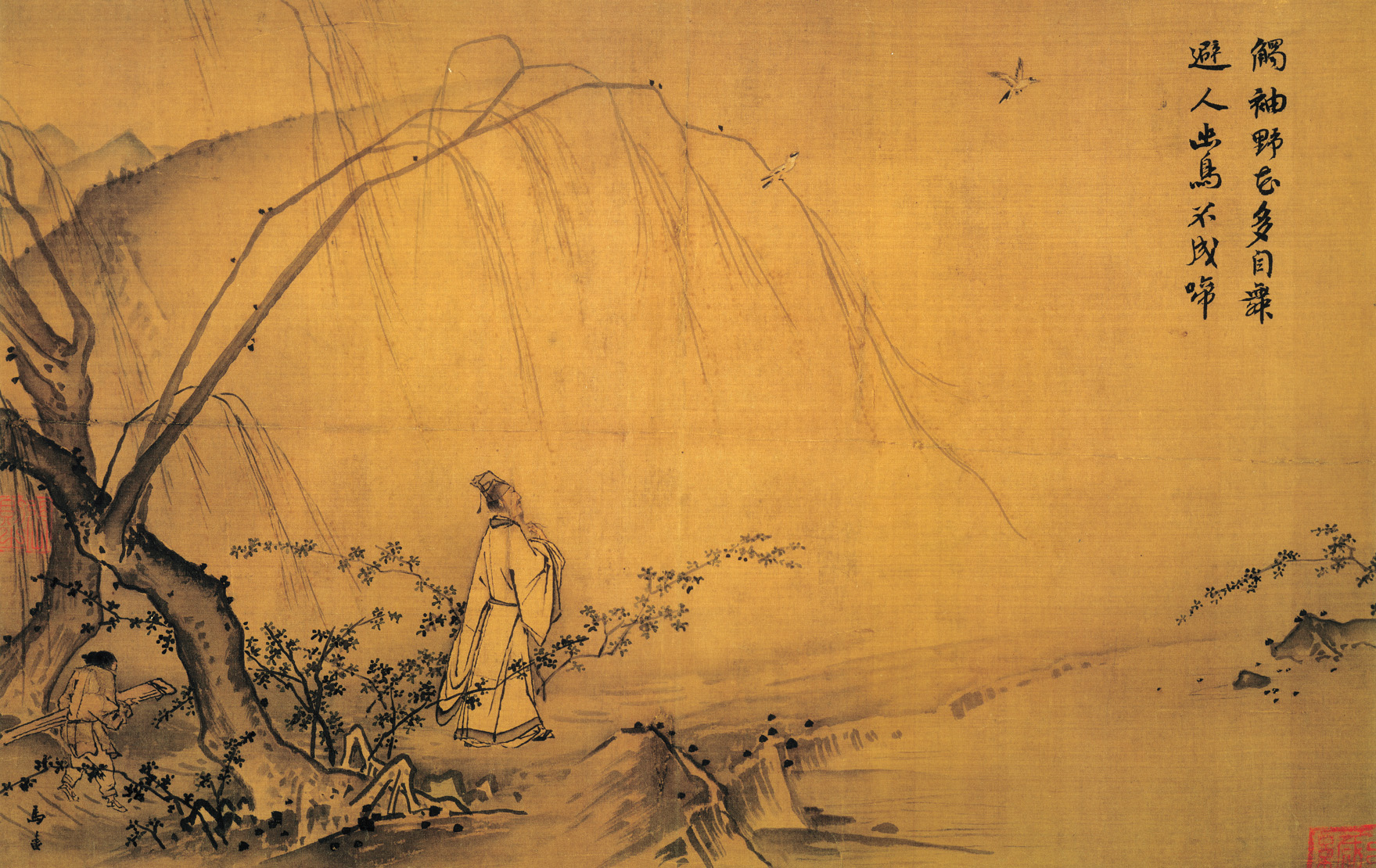 Apparently, walking stimulates creative reasoning, but sitting is better for focused understanding.
Stanford Study on Walking and Creativity
Apparently, walking stimulates creative reasoning, but sitting is better for focused understanding.

“I am sitting with a philosopher in the garden. He says again and again, “I know that that is a tree”, pointing to a tree that is near us. Someone else arrives and hears this, and I tell him, “This fellow isn’t insane. We are only doing philosophy.”
Wittgenstein, On Certainty, (467)
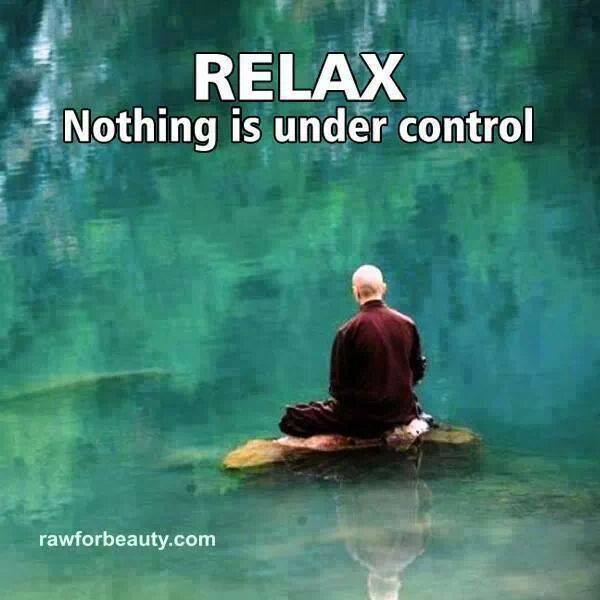
 Just saw Catherine Malabou on Berkeley campus give a lecture in which she surprisingly argued that while most translators and scholars of Plato say that the philosopher should not go back down into the cave, as they will be killed by the common people like Socrates, Plato hints through using myth at the very end of the Republic that the philosopher should go back into the cave and dwell among the people, but avoid being recognized as sovereign by remaining fluid, sovereign and common in an unrecognizable state. I have never heard of such a reading. Everyone always assumes that Plato was an outspoken authoritarian.

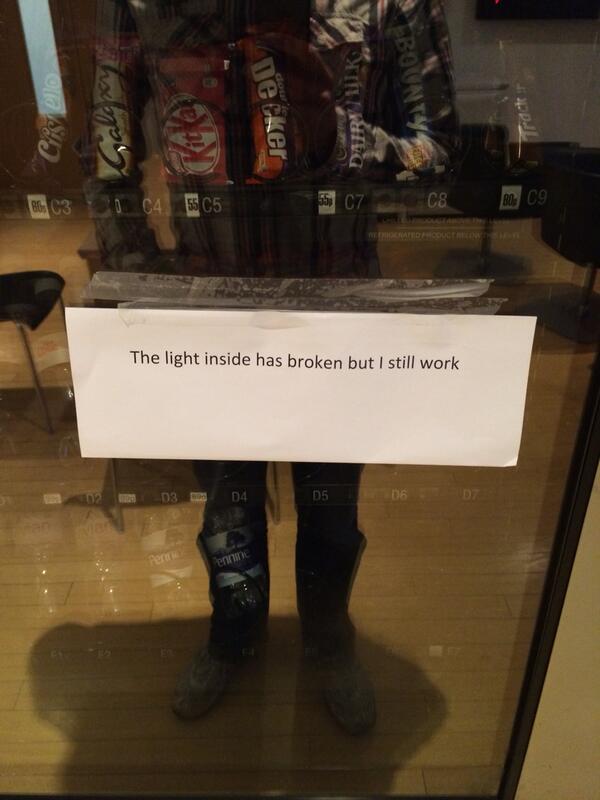
Vending machine, having an existential crisis

In Paul Ziff’s Semantic Analysis, he argues that the meaning of an utterance is not simply the physical situation to which it refers. Meaning includes connotation.
“The glass is half full” refers to the exact same situation as “The glass is half empty”, because a glass that is half full is by necessity a glass that is half empty, but they do not mean the same thing, as the connotation is different for each. The first is optimistic, indicating that one still has more, while the second is pessimistic, indicating that now one has less.
One would say, “Fill the glass half full”, but not, “Fill the glass half empty”.

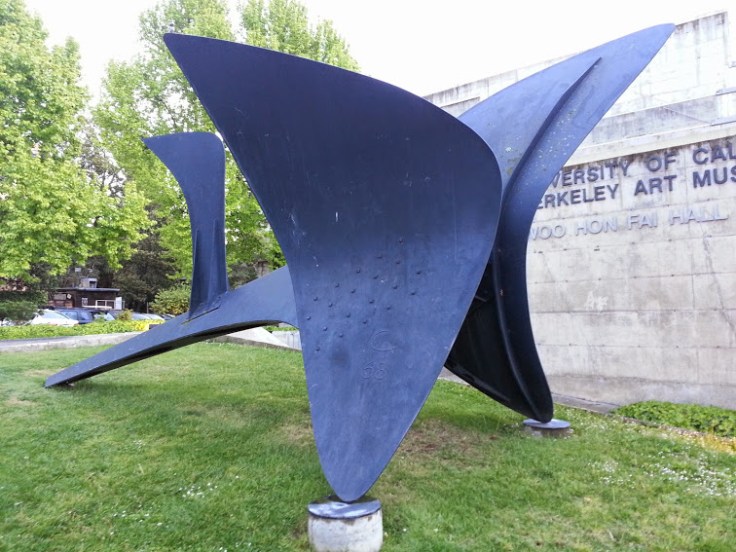
Many years ago, as I was arguing with a friend about subjective and objective truth, we passed by the Berkeley Art Museum, and I gestured to this statue, remarking that different people could interpret this in different ways. My friend replied that it was clearly an anchor from a large ship. I laughed out loud, as I could now see it as an anchor, but I replied that it was no longer an anchor, but a piece of art outside a museum. That exchange has stayed with me. What does it mean about our culture that anchors can be abstract statues, and statues can be recognized as former anchors?

 Thought Itself