Search

Thought Itself

The History of Philosophy, Logic & The Mind with Eric Gerlach

Category

Philosophy

Buddha & Descartes, Thought & Thinker

The opening lines of the Dhammapada, the collected sayings of the Buddha, read:

We are what we think.  All that we are arisBuddha Statue Taiwanes with our thoughts.  With our thoughts we make the world.  Speak or act with an impure mind and trouble will follow you as the wheel follows the ox that draws the cart… Speak or act with a pure mind and happiness will follow you as your shadow, unshakable.

Speaking and acting are the two ways one uses one’s mind to draw trouble or happiness from the world.  This fits with Merleau-Ponty and Wittgenstein, who said that when we speak, our words are our thoughts, with no separation between speaking and thinking.  The same applies to acts.  Perhaps all thinking is rooted in speaking and acting.  Perhaps picturing something in the head is rooted in the experience of looking, moving one’s eyes, head, neck and body such that a thing comes into view.

Descartes statueDescartes famously wrote, “I think, therefore I am”.  Both Buddha and Descartes reason that if there is thinking, then there is a thinker, but they see this relationship in opposite ways.

For Buddha, the thinking is the coming into existence of the thinker, such that there is no thinker without thought making it so.  The thinking causes the thinker to be a particular thing.

For Descartes, the thinking is evidence of the thinker, leading to the conclusion that there exists a thinker prior to and independent of the thinking.

Universe Wants Its Bottle

NASA Pillars of Creation

Nietzsche, Hegel & the Germans

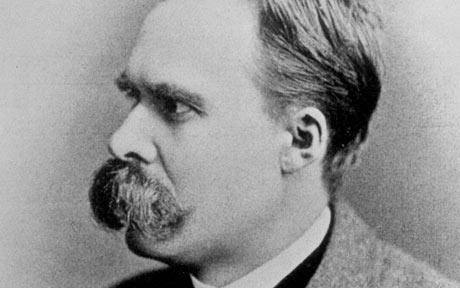
nietzscheWe Germans are Hegelians even had there been no Hegel, insofar as we (as opposed to all Latins) instinctively attribute a deeper meaning and greater value to becoming and development than to what ‘is’; we hardly believe in the justification of the concept ‘being’.

Friedrich Nietzsche, The Gay Science, §357

Thanks to my good friend Roberto for snagging this quote!

The Dying Murderer

XIR24990One of my students in Greek Philosophy, discussing the Stoic ideal of accepting fate, said that when she was growing up she heard a story about a boy whose entire family was murdered.  After spending his life searching for the murderer, the boy, now a man, found the murderer was about to die.

The murderer begged the man to kill him and end his suffering, but the man refused to punish the murderer.  Now the man wondered why he had spent his life trying to kill his family’s murderer when time was already going to do it for him.

Ethics, Explained

One of my Ethics students sent me this amazingly awesome Saturday Morning Breakfast Cereal comic about the Trolley Problem.  Pure gold!

Ethics Dilema

Comic: Philosophers Giving Lousy Tech Support

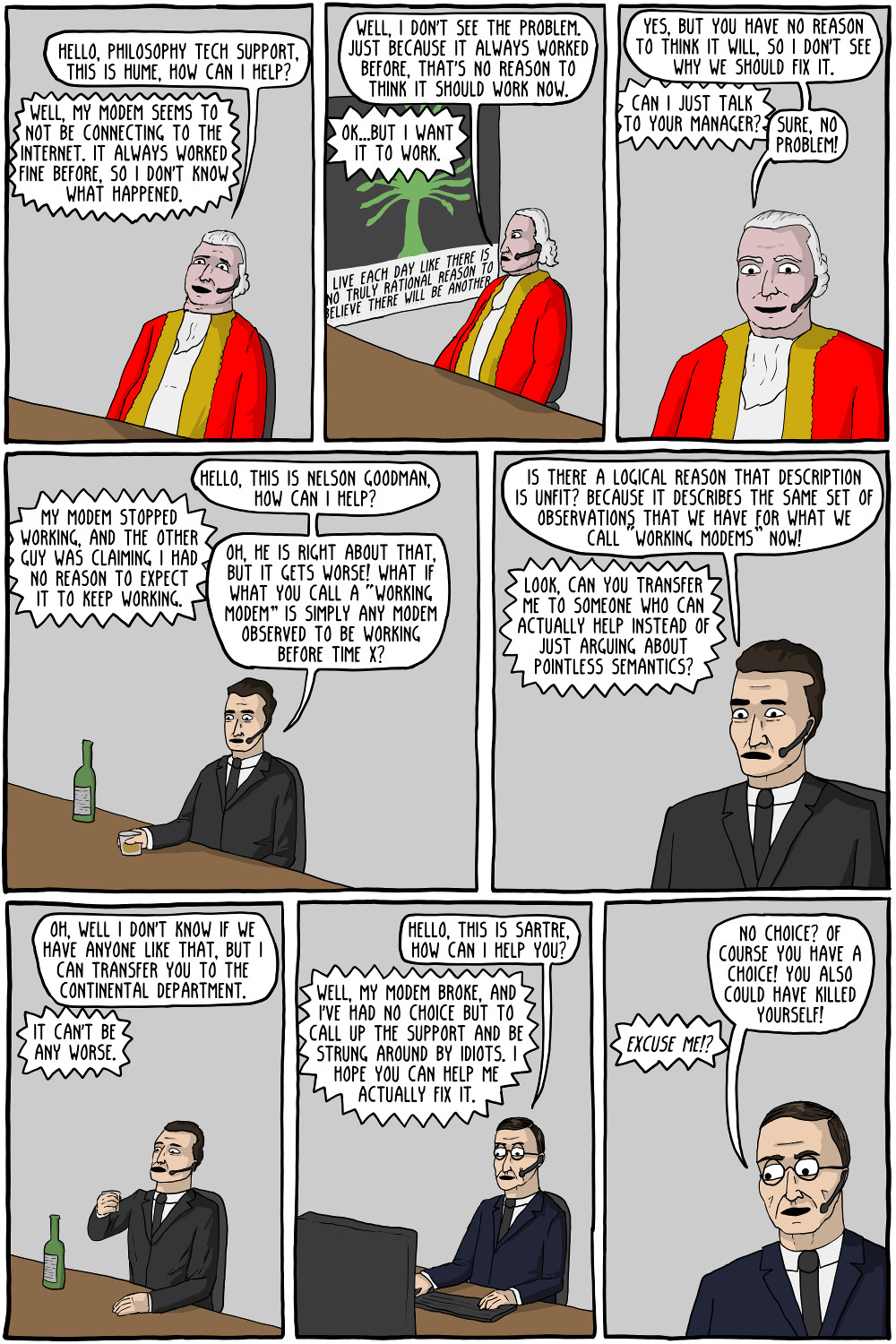
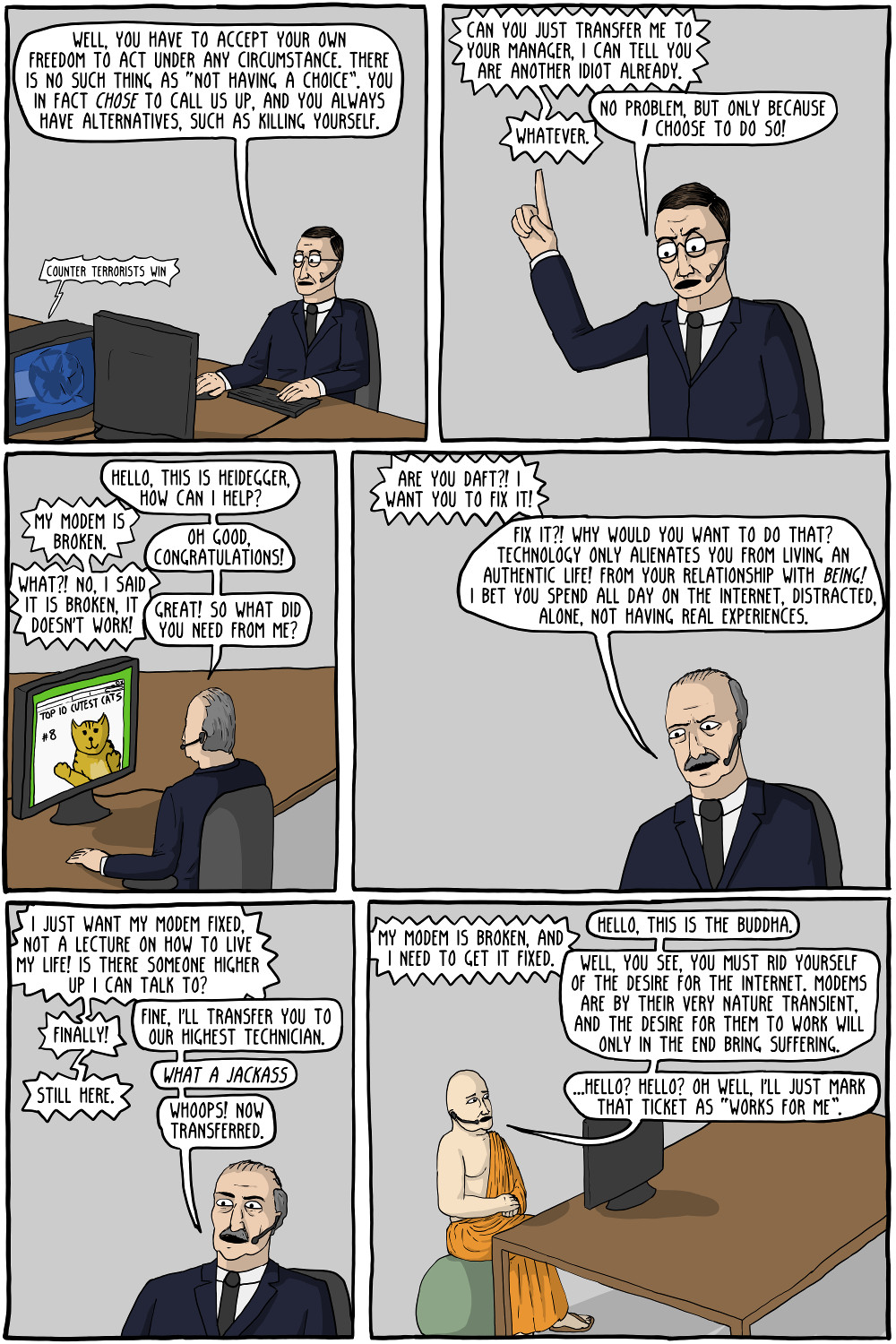
Another excellent Existential Comics about how Hume, Goodman, Sartre, Heidegger and Buddha would ask you to accept the problem with your modem: http://existentialcomics.com/comic/51

techSupport1

techSupport2

The Groundless Grounds of Wittgenstein & Heidegger

Groundless Gounds A Study of Wittgenstein and Heidegger Lee BraverA friend of mine recently brought Lee Braver’s book Groundless Grounds: A Study of Wittgenstein and Heidegger (2012) to my attention, and I must say, it is so far an incredible book.  In the introduction, Braver sets out the overall frame of the book, which should be of some interest to anyone concerned with the similarities of the early work of Heidegger and the later work of Wittgenstein:

Both Heidegger and Wittgenstein argue that philosophy that suspends our activity in the world, taking a disengaged theoretical stance, is a problem (Ch 1).  Both argue that this problematic view comes about by conceiving of things as changeless, self-contained objects (Ch 2).  For Heidegger, this is the “present-at-hand”.  For W, it is atomism and private language.  Such bare inert objects do not give us a proper and full view of human life and meaning.  Both argue that we need to see things as holistic and interdependent (Ch 3).  While reality has been primarily understood in terms of knowledge, thought rests on non-rational and unjustified socialization, which includes our spontaneous and responsive activity (Ch 4).  This new conception of thought has particular ramifications, calling into question the Law of Non-Contradiction (Wittgenstein) and the Principle of Reason (Heidegger) (Ch 5).  Our lack of justification in thought does not make thinking worthless.  Rather, it shows us what we take as “groundless grounds”, what we rely upon even if it is always somewhat and in some ways unreliable.

Duck-Rabbit War

Duck Rabbit War (by Paul Noth)

Racism & Protest

ferguson missouriAs the news was unfolding about protests in Ferguson, Missouri yesterday, I was reading my Ethics students’ papers about social issues, including racism.  One of my students shared a personal story that was powerful, and I asked her if I could share it with future classes.  I am going to share it with you all as well.

civil rights imageAs a student in college years ago, she took a job at the college gym.  Her supervisor told her that if anyone came into the gym who looked like they did not belong there, she should walk over and offer them a tour, as this often discouraged trouble makers. As a black woman, this troubled her, as she had many experiences feeling unwelcome and suspect, and she asked her supervisor what qualified people as “not-belonging”.  Her supervisor told her that she would just know.  Feeling uncomfortable with this task, she opted out of the job.

protest ferguson hands up don't shootWeeks later, she returned to the gym to exercise, and a student-worker stopped her and asked her if she wanted a tour.  When she became angry, and demanded to know why she was being stopped, the worker called the campus police, and she was barred from the gym.

Her protest was seen as proof that she did not belong.

Blog at WordPress.com.

Up ↑