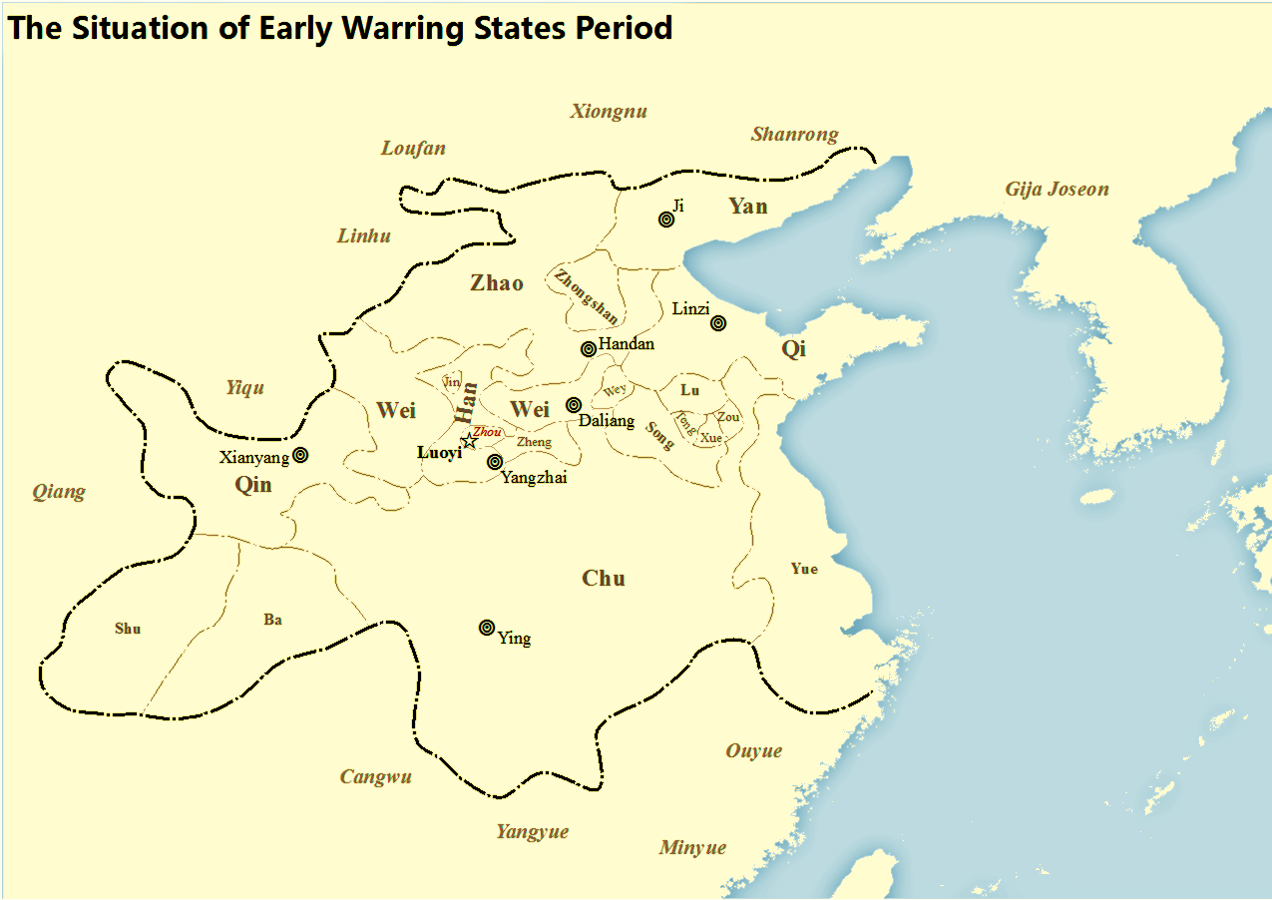
 The School of Names (Mingchia) was a philosophy of Warring States China that took great pleasure in debate and confusing everyone with words. The first was Deng Xi (546 – 501 BCE), the first famous lawyer of ancient China, who used and taught wordplay for court trials, would often argue both sides of a case, much like Pyhrro of ancient Greece, and argued that contradictory judgements can both be true, as things are arguably good and arguably bad both. For this he was executed for making contradictory statements others struggled to explain after the state fell into disorder.
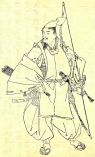 The School of Names are sometimes called the Sophists, or the Dialecticians, or the Logicians, though these names also fit other schools. Of the Greeks, they are quite similar to the Eleatic paradox proposer Zeno, who argued that the tortoise can never catch Achilles if there is an infinite regress of halves to complete the whole distance separating the two. The two famous first and last masters of the school are Hui Shi (380-305 BCE), good friend of the Daoist Zhuangzi, and Gongsun Long (325 – 250 BCE), who infamously argued a white horse is not a horse. The works of the Dialecticians have been lost, except for many mentions in the book of Zhuangzi and the partially preserved in the Gongsun Longzi.

Many in ancient China and modern scholarship have dismissed the paradoxes of Hui Shi, Gongsun Long and the School of Names as silly nonsense. Xunzi, the cynical Confucian who argues against Mencius that human nature is evil and all good comes through education, says that some (he doesn’t name, but clearly the School of Names) would not follow the early kings or say there are rules or standards, but liked to argue strange theories and entertain strange propositions in subtle ways that don’t satisfy real needs, doing much work for little results, and abusing names to sew chaos throughout the land, but he adds, however, their views have some basis and statements some reason, enough to trick and confuse most people.

The Zhuangzi says there are some who strangely live by proving the impossible is possible, and affirming what others deny. Hui Shi appears several times in the text, a known friend and debate partner of Zhuangzi, and Gongsun Long is quoted as saying: When I was young I studied the ways of the early kings, and grew to understand how to practice compassion and righteousness. I unified the same and different, and affirmed what others denied. I confounded the wisdom of all the philosophers, and refuted all arguments brought against me. It seemed that I was wisest. All of this puts the Daoists in alliance with the School of Names, but we also are told in the Zhuangzi that the School of Names could overcome words but couldn’t convince minds, and this was their weakness, and that Hui Shi thought himself the best at debate, so he contradicted others well but was never at ease with those he debated.
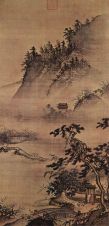 In the text, Zhuangzi and Hui Shi are walking by a river dam and as the fish darted around, Zhuangzi said the fish were certainly happy. Hui Shi asks him how he knows that if he is not a fish. Zhuangzi asks Hui Shi how he knows he doesn’t know that, if Hui Shi isn’t him. Hui Shi says he still doesn’t see how Zhuangzi knows what it is like to be a fish, and whether or not it is happy, so Zhuangzi says they should back up, and remember that Hui Shi asked him how he knows the fish are happy, so Hui Shi has already admitted, in the beginning, that he knows that, namely that the fish are happy. Hui Shi is presented as foolish compared to Zhuangzi several times, but Zhuangzi also says at Hui Shi’s grave that he now has no one to argue with.
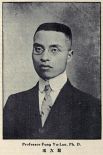 The School of Names leaves behind 31 paradoxes, the first 10 of Huishi and 21 others included in the work of Gongsun Long. These brilliant puzzles have been neglected, dismissed and misunderstood by too many. Several scholars claim they are meaningless, and had no influence at all after their time. Feng Youlan, who wrote the great modern work History of Chinese Philosophy (1931, with the English following in 1937) gives the paradoxes more credit than many, but he argues that the paradoxes rely on a particular understanding of universals, mental categories that are absolute.
 Bernard S. Solomon, one of the only authors who has written on the School of Names recently in English (On the School of Names in Ancient China, 2013), follows Feng’s interpretation, adds that the paradoxes are based on our conditioned, predictable responses to words and statements, and uses an illuminating metaphor that shows how our intuitive understandings can hurt rather than help us understand them:
In studying these texts, we are often in the position of the person, listening behind a closed door, who hears the statement, “He landed on me on Atlantic Avenue,” only to find when he opens the door that the reference is to the game of Monopoly… If the eavesdropper is from Brooklyn, he will recognize Atlantic Avenue as a major thoroughfare, knowledge that, until he opens the door, may keep him from guessing that the reference of the statement is to a game.
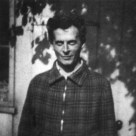 The key to understanding each of the paradoxes is quite Wittgensteinian. Feng Youlan, student of the American Pragmatist John Dewey, was well acquainted with Wittgenstein’s Tractatus, which ends with silence, translated into Chinese in 1927 and discussed by Chinese intellectuals in the 1930’s. Feng writes in his autobiography that while he was giving guest lectures at Oxford on Chinese philosophy in 1933, Wittgenstein invited him to his rooms for tea, and Feng does not give much detail to their conversation but concludes, “I found there was quite an affinity for our views.” Feng thought he and Wittgenstein could help resolve the crisis of metaphysics, the problem of establishing fundamental elements of logic and meaning, by constructing different versions of a new Daoist philosophy of silence.
 Ironically, however, a better Wittgensteinian solution to each paradox is found not in the early work of Wittgenstein, found in the Tractatus and work before the mid-30s, which relies on ideal, universal types, but on his later work, such as that of the Philosophical Investigations, after he turned away from the universals that Feng and Solomon both read into the paradoxes, which is overthinking many of them beyond simpler solutions. Later Wittgenstein rejected the idea that things have singular meanings, and saw meaning as dependent on complex situations. The School of Names made good use of the word call (wei), such as Gongsun Long stating that a white horse can be called for with the word horse, but not any horse can be called for with the words white horse. There are also a few that rely on ancient Chinese having neither plurals nor articles, so a way, and the way, and ways are all said using the same word way.
 Hui Shi’s first paradox is there is nothing larger than the largest thing, which is the larger measurement, and there is nothing smaller than the smallest thing, which is the smallest measurement. Zhuangzi, Hui Shi’s friend, says the Cosmos isn’t large and the tip of a hair isn’t small, as there are larger and smaller things, measuring each against the smallest and largest. Why measure the largest things continuously against a thing that is largest, and otherwise unnamed, or the smallest against the smallest, otherwise undefined? If there is no largest or smallest things that can be named, then we can call any large thing small compared to the large itself, and any small thing large compared to the small itself. There is a Chinese proverb that says a foot can be short and an inch can be long.
 Hui Shi’s second paradox is what has no thickness can’t be piled up, but it can cover a thousand miles. Many, including Feng, suggest atomism, that Hui Shi, like Kanada of India or Diogenes of Greece, is suggesting there is a smallest thing, and conversely that the Cosmos, as object, is the largest thing, but this is not stated, and contrary to the relativistic use of language of the rest of the paradoxes, as well as Zhuangzi’s similar language that matches with each, as the Zhuangzi tells us a knife’s edge has no thickness, regressing to a point. Hui Shi is likely speaking of an idealized edge or straight line, which has length but no width.
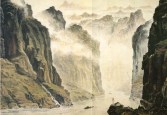 Hui Shi’s third paradox is heaven is as low as the earth, and mountains and marshes are on the same level. Many of these paradoxes use words in counter-intuitive ways, in ways that are true, but only somewhat true, true here but not there, such that it can be said that mountains and marshes are on the same level, where they meet in the middle, on the horizon, or at our feet, but it can also be said, contrary-wise, as Tweedle-Dum says, that mountains and marshes are also not on the same level, wherever they are not meeting in the middle, which is most of them. Many scholars get the answer to this paradox, but don’t see that this very sort of relative word use, using words that are true on one part of the elephant, but not another, solve the majority of the paradoxes of the School of Names easily. Is this mere nonsense, or does it show us how words, our minds and our world work?
 Hui Shi’s fourth paradox is the sun is setting at high noon, and living things die as soon as they are born. Heraclitus of Greece says being and non-being are endless becoming continuously together. Heidegger, the German who loved both Heraclitus and Chinese Daoism, said that authentic being is being-towards-death. Anything that begins is, in its process, changing and dying continuously in order to exist and continue as it is, including the Sun that rules over cycles in ancient Greek and Chinese cosmology.
 Hui Shi’s fifth paradox says the smaller sameness, the lesser similarity, is that large sameness is different from small sameness, but the greater sameness is that all things are similar and different from one another. This is quite confusing without a concrete example. Consider a bowl of apples and oranges. All are round, all are fruit, and all are edible, yet it is easy to see that the apples are more similar to each other than the oranges. It is easy, and thus it is lesser, to see that apples are not oranges and oranges are not apples. It is difficult, obscured by this easy judgement and thus greater, to see that no two apples or oranges are alike and, at the same time, all contents of the bowl are alike. It is easier to see the categories of apples and oranges than it is to see that similarity and difference do not stop at the categories they create for us, but go clear beyond them to unite everything in similarity and difference.
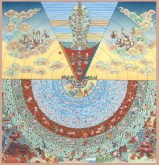 Hui Shi’s sixth paradox is that the South has no limit, yet has a limit. Where is the South? Anyone can say that South is south of them, and it extends endlessly beyond each of us southward, so the border of the South, and the North, East and West, is each of us as individuals who use these words. This paradox is key for understanding the solutions to several of the others of the later School of Names.
 Hui Shi’s seventh paradox is someone goes to Yueh, a neighboring state, today and arrives yesterday. If someone crosses the border of Yueh at the stroke of midnight, with one foot in each province, then one was in Yueh and not in Yueh both today and yesterday, so one could say that one was going there today and arrived yesterday. We can also say that we were going to Yueh today and yesterday, and arrived there today and yesterday, but you can select the parts to say that are most paradoxical. This is very similar to Gongsun Long’s white horse is not a horse argument, as it is the third paradox of mountains and marshes on the same level at one specific place, but not everywhere else, but this paradox is temporal rather than spacial.
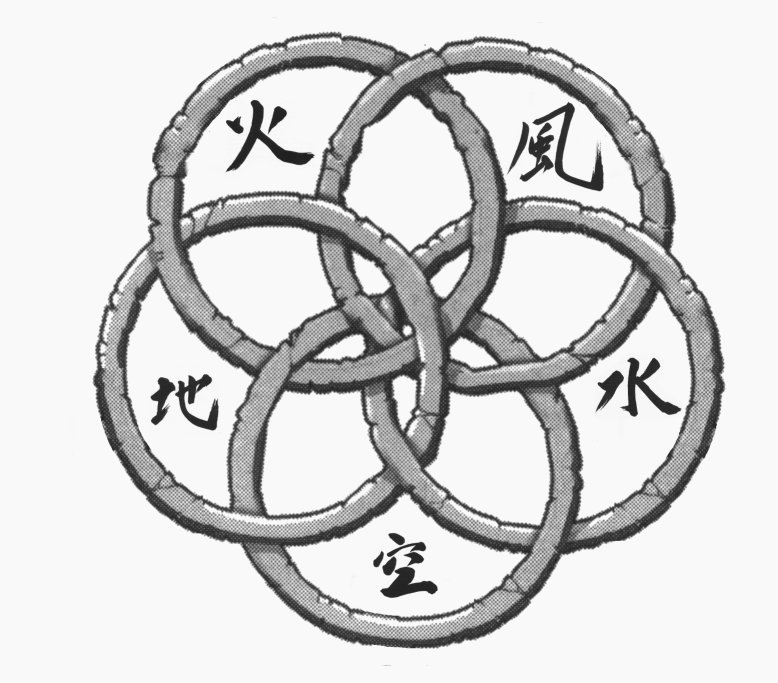
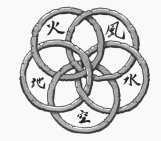 Hui Shi’s eighth paradox is chained rings, like those used in Chinese and later Arabic and European magic acts, are separate. A chain is separate in each ring, such that we can point to each link and say it is a wholly individual thing, and then we can point to the chain as a whole and say it is a wholly integrated thing, including all the links together beyond themselves. There is a suggestion here about the Cosmos and the self much as Daoists would suggest, that the whole is the parts, but the parts are also the whole, contrary-wise.
 Hui Shi’s ninth paradox is the center of the world is north of the northern provinces and south of the southern provinces, which is only possible if the center is in both different and separate places, so space doesn’t exist, we are told. This paradox closest resembles the Eleatics of Greece, such as Zeno, who argues impossibly that the tortoise never reaches Achilles. If we follow the logic of the last several paradoxes, particularly the sixth about the South, people are the center of the Cosmos, each of us, such that we share love, hate, white, black, sweet and sour equally, without distance, such that love and sweet are called the same by us everywhere, but we each are the center separately, such that space doesn’t exist, but also does, in different ways. If people live to the north of the northern provinces, and south of the southern provinces, then we, the center of the world, are in different and the same places and place.
 Hui Shi’s final tenth paradox is we should love all things as heaven and earth are one. It can be said that heaven and earth are one, called the Cosmos together as one name, and it can be said that heaven and earth are not one, as they can both be called by separate names. In the same way, each and all of us can be called humanity, or the Cosmos, and then be called by our individual names. This fits well with the set as a whole, including the last several, such as the South, the border, the rings, and the center.
 There are 21 additional paradoxes that follow much of the same logic as Hui Shi’s ten, and it is not known which of these, including Hui Shi’s, came first or last in the school. As they are presented in the Gongsun Longzi, we will continue numerically and call the first the 11th, which is oddly that an egg has hair. If an egg contains a mammal, then the egg, in a sense, has hair as soon as there is hair inside, though it certainly can’t be said that an egg has hair on the outside, as it is quite bald.
The 12th paradox is a chicken has three legs. Ancient Chinese does not have plurals, so when we say chicken leg, it can refer to the left leg, right leg, or the pair of the two, which can be called by the same word, which gives us, and the chicken, three legs. Feng and Solomon suggest that the third leg is the universal, such that chickens participate in the group of things with legs, but the way the word can call for all three things is simpler. The Gongsun Longzi says, “Speaking about a leg of a chicken is one, the chicken’s legs are two, and two and one make three,” which is tricky, because the chicken’s legs are two as one of the three, not two of the three, each leg as one being the remaining two.
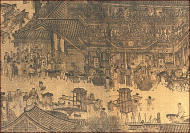 The 13th paradox is the capital of the empire, Qu, contains the whole world, and if so, the world has no width. Analogously, if our minds and hearts are the capital center of our bodies, including the whole together in experiencing every part, which is how we can dream we feel pain in our foot, then the capital city is concerned with the whole known world and all the empire, just like reality beyond the body, which is very much “in the mind”, and so space is and isn’t real, and the world has width, but doesn’t insofar as it is all contained together in us, much like Hui Shi’s ninth paradox of each self as center.
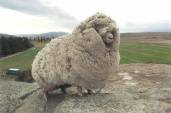 The 14th paradox is a dog can be a sheep. A dog can be taken for a sheep, particularly in the dark, as Gautama says a man can be mistaken for a pole, so if the group sheep includes things which we can call for with the word sheep, then if we mistake a dog for a sheep, call for the dog with the word sheep, and the dog either comes to us or someone goes and gets the dog who is as clueless as we are, we did use the word sheep to successfully call for the dog. This is still a problem in modern philosophy, as many say accidentally being right and not knowing how you are right, such as successfully calling for the dog, is something we often say is still being wrong.
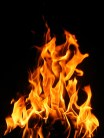 Skipping a few like those we’ve covered, the 17th paradox is that fire is not hot. It can certainly be said that fire is hot, if our hand is in the fire, or we are a few feet away, but it can also be said that fire is not hot, certainly if we are a hundred feet away, or out in space watching on a screen via satellites, so fire is hot, but fire is not hot, relative to where each of us is, the center of the Cosmos, relative to the fire. We have expectations with using words, much as we do with Hui Shi’s mountains and marshes on the same level, but the words are reasonable if we consider they are positioned in a situation.
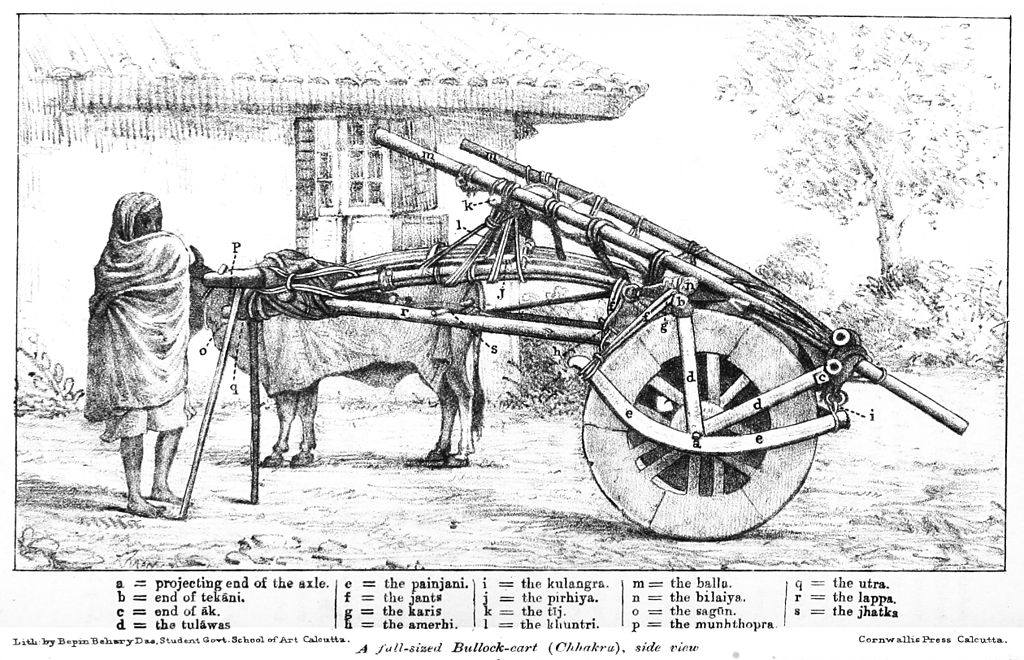
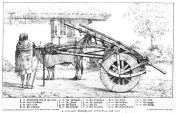 The 19th paradox is the wheels of a cart do not touch the ground. Most of the wheel doesn’t touch the ground most of the time, other than a single point in its circumference that runs the length of its width, so a wheel almost two dimensionally touches the ground as a three dimensional object. Again, it does and doesn’t, and actually mostly doesn’t, which is odd, because we would say wheels touch the ground for our purposes, unless we use pulleys, or screws, or steering wheels, and many other forms of wheels that may or may not be part of a cart. The analogy can serve as quite a vehicle. Feng says that wheels do not touch most of the ground, which is also true.
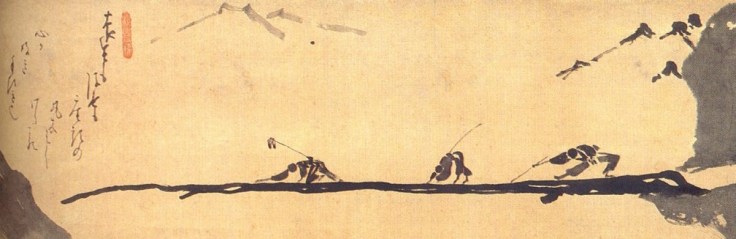
 The 20th paradox is the eye does not see. The eye doesn’t see what it doesn’t all day, like Paris isn’t seen by the Charvakas, then or now. The eye sees things and doesn’t see others. If we consider the blind men on the log bridge of Zen, it would seem we can see things that don’t see as well, and know it. We could say, “You can see here how the blind man doesn’t see the log over there?” and say yes, as we understand.
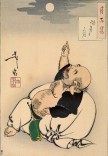 The 21st paradox is the pointing of a finger never reaches the thing, and the reaching never ends. The Gongsun Longzi says that heaven, earth and what they make are things, with each thing what it is, but there are also designations (chih), the word finger to mean point out, pick or designate. When we point, we define demonstrably, and we point designate, but also implicate a sort of thing without designating any particular thing, like using the word point to mean designating in general. Feng chooses to call these universals, with the same problem this term has, as opposed to general in translating Aristotle. If I point to an ox, and I don’t just mean this ox, and say oxen, do I mean things that are exactly or only generally like this? The word finger is also translated as idea, or concept, much as a word “points” to things, and Heraclitus uses the word word for idea. The paradox says that definitions never fully define anything, and the defining of things in words never ends. This is very late Wittgenstein, and why we don’t think of apples in paragraphs, nor have we finished explaining them in words.
 The 22nd paradox is a tortoise is longer than a snake. Certainly we can say that a fairly large tortoise is longer than a baby snake stretched out, or a large snake coiled up tightly. Again, the mountains and marshes relative, situational logic brings to mind examples easily.
The 23rd paradox is a quadrilateral is not quadrilateral, and a circle cannot be considered round. We could bicker about how there are no perfectly straight lines, so all so-called four or one-sided shapes actually have varying sides depending on how we define it, but if we consider this quibbling, there is a more obvious answer. A four sided figure that is two dimensional, on paper, has five sides, including the side of the figure facing us, the enclosed, empty part of the figure which is included as part of it, and can be called a “side”.
 If the figure is cut out of the paper and hung in space, it has six, including the front and back sides, even if we assume the paper is perfectly two dimensional, which it isn’t, but if it isn’t and we assume the sides are straight it has six sides regardless. As for the circle, a 2D circle certainly can’t be said to be round as a 3D globe is, as it is clearly flat on two sides, and not round overall. It is, like the wheel touching the ground, only round in one, narrow, single dimension, and in all the rest round it, it isn’t round in the slightest, but flat, and in ancient China, straight and curved are classic opposites that refer to order and chaos. Tortoises were used for oracles in early ancient China because the resembled the cosmos, round on top and flat on the bottom.
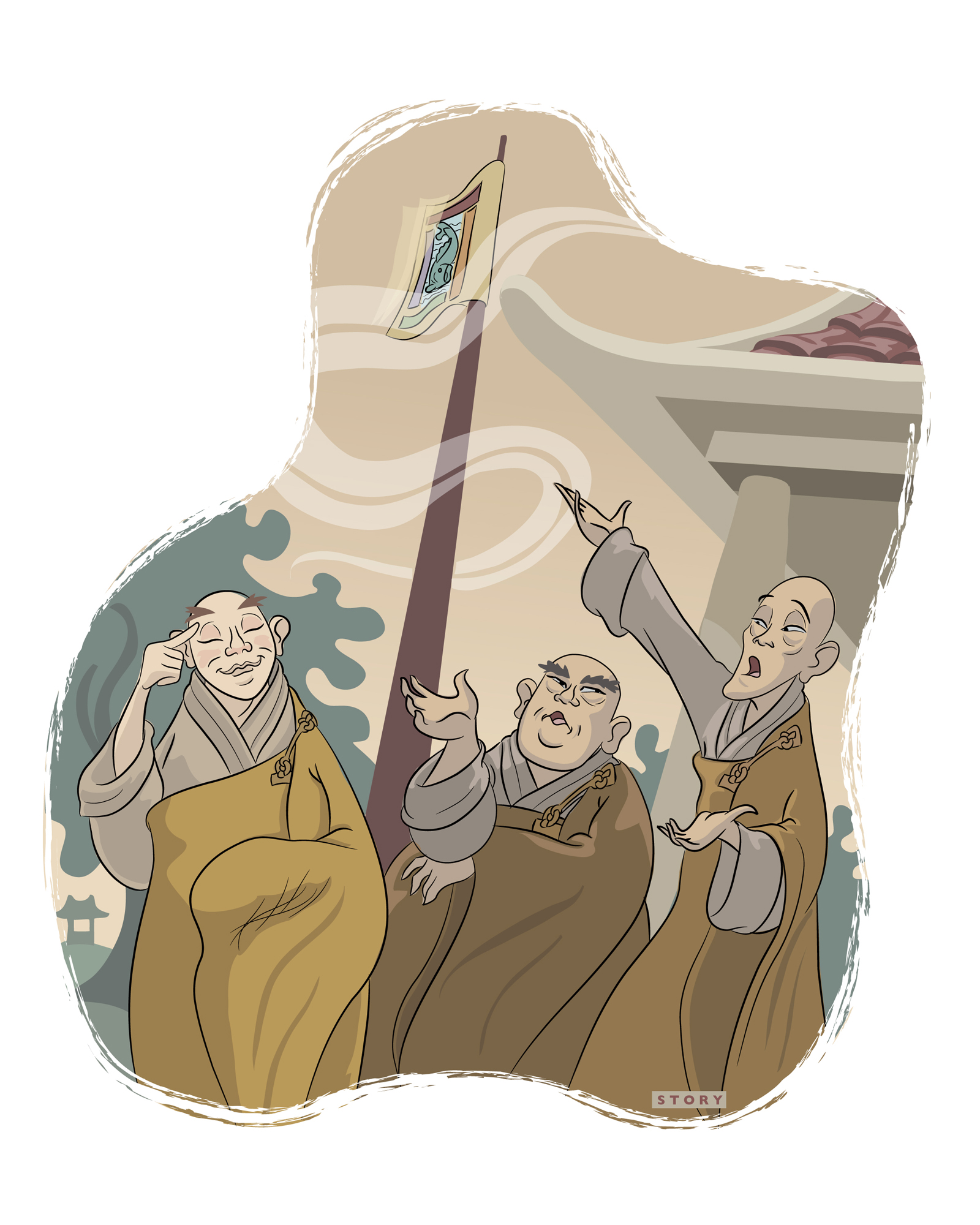
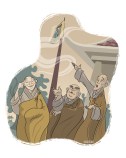 The 25th paradox is the shadow of a flying bird never moves. Feng goes to the Eleatics and the universal, arguing that the shadow doesn’t move at each moment in time, but there is a simpler answer, which is a logician in India, Greece or China arguing about cause and effect might say that the shadow doesn’t move, because it is the bird that moves, and the shadow moves with the bird, caused by it, not moving itself on its own. Huineng, central patriarch of Chinese Chan (Zen) Buddhism, told two monks debating about whether it is the flag or the wind that is moving, the visible or the invisible, the physical or the mental, that it is not the flag or the wind, but their minds that are moving.
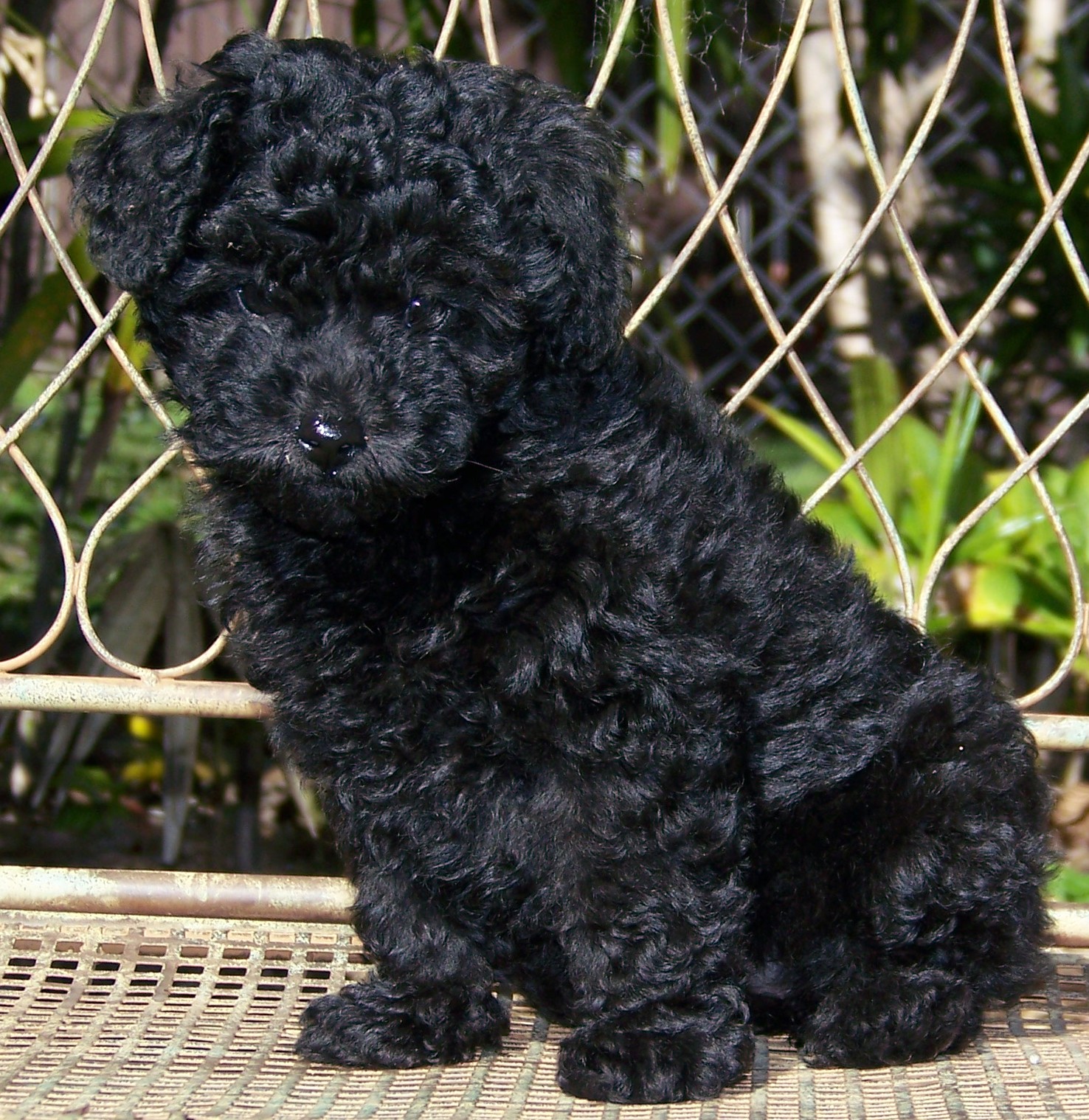
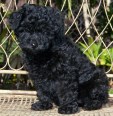 The 27th paradox is a puppy is not a dog. Like the white horse we have yet to discuss, if I tell a small child I will bring them a puppy, and then bring them a full grown dog instead, and say it is the same thing, the child might not feel the same way, and feel quite sad, expecting a young puppy. In this way, it cannot be said that a puppy is a dog, but insofar as a puppy is a young dog, it certainly can be said a puppy is nothing other than a dog, even though it is an animal, and the Cosmos, as well as its own center.
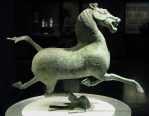 The 28th paradox is a brown horse and a black cow are three. Like the three legged chicken, if they are a group together, with the pair called, singularly in Chinese, “dark, four-footed animal(s)”, then there are three “animals” here, the horse, the cow, and the animal(s) of the pair.
 The 29th paradox is either a white dog is black, or a black dog is white, as I confusingly have read both translations, possibly from differing sources. Either way, a white dog is black in places, on its body, and inside certainly, and the same can be said of a black dog, in the whites of its eyes, and bones, even in the dark of its insides. Wittgenstein asks if a red rose in the dark is red in our minds, and it is and isn’t, strangely looking red, but understood, like the blind men in the paintings of Zen master Hakuin, to be without image, which we can see.
 The 30th paradox is an orphan foal has never had a mother. In the Daoist text of Liezi, an aristocrat who admires Gongsun Long tells us the solution, that the foal wasn’t an orphan when it had a mother, so it can’t be said at any moment in time that it is an orphan and has a mother. He is told, presumably by a Daoist, that if Gongsun Long blew all this out the other hole, the rich guy would likely believe it the same. The aristocrat gets quiet, and says he will speak of this another day.
 The final 31st paradox is if you take a stick a foot long, then take away half each day, it will never be fully gone. This infinite regress is almost exactly the same as what the Mathemagician tells Milo in The Phantom Tollbooth, which I read as a kid, that if you divide things again and again it never seems to end. Feng and others who suggest the School of Names are atomists, who argue that there is a smallest thing and nothing smaller, don’t seem to follow the infinite regresses that the School of Names paradoxes clearly share with the Daoists, found throughout the language of the Zhuangzi.
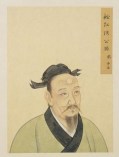 Gongsun Long (325-250 BCE) was famous at debate during the Warring States period, and he hated the terrible state of language, used in deception and lies by warring parties. It seems, like Deng Xi and Hui Shi, that Gongsun Long decided to cynically show the holes and blind spots of words and language rather than give us principles to live by, as Xunzi the Confucian, who believes in rectifying the names, clearly hates. Gongsun Long stayed with the aristocrat Ping Yuan of Zhao, where he met Kong Chuan, a Confucian, who offered to study with him if he renounced the white horse argument, but Gongsun Long said he would not, as this is what he is known for, and without this he has nothing to teach. This suggests most if not all of what he saw is found in this and the other paradoxes, namely pointing to this or that, but not all, with language.
 Gongsun further tells him that the King of Chu lost his bow on a hunt, but when his servants offered to search and find it, the king nobly said that a man of Chu had lost a bow, and a man of Chu would find it, meaning as long as someone of his kingdom found and used it things are fine as they are, men of Chu interchangeable in his eyes. Confucius heard this, and criticized it, saying that the king should have said a man, and not a man of Chu, as the king should have included everyone outside of Chu in his statement. Gongsun Long asks the Confucian, if a man and a man of Chu are not the same thing to Confucius, are a horse and a white horse the same thing to the Confucian? Kong Chuan had no reply.
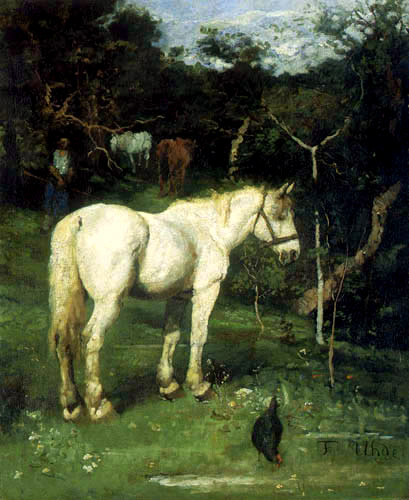
 Gongsun’s writings are now lost, but his infamous A White Horse Is Not A Horse argument lives on. Many say that this argument is faulty, but if we follow the thinking of the Daoists and Hui Shi we can see that they are quibbling, and Gongsun is showing us the two types of is, the two found on the top and bottom of Aristotle’s Square of Opposition. Gongsun does not mean that a white horse is not in any way a horse, but that saying “a white horse” is not the same thing as saying “a horse” when we use the words in a situation. He argues that if one brings a yellow horse, it would not fit the description “a white horse” but it would do fine for the description “a horse”. The two are thus different sets and are not identical though one set is a subset of the other. This again follows the mountains and marshes on the same level logic of Hui Shi.
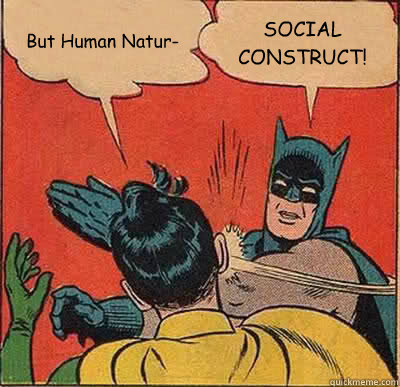
 Consider that you are your finger, but you are also not simply your finger. If we use “is” in terms of strict identity (like Clark Kent is Superman) then your finger is not you because you are much more than a finger. However, if we use “is” to mean a part incorporated within a thing (like a tree is green, or trees are green things) then your finger is you because it is part of you. If Batman is blue, and my car is blue, this doesn’t mean my car is Batman. Bill Clinton famously tried explaining this as a lawyer with his “that depends what your definition of ‘is’ is”, which did not gain him much sympathy. Being an individual human, you are and are not humanity. In fact, you are only one human out of quadrillions so far, so you are not very much of humanity at all, but what are you more than a human?
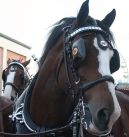 Gongsun Long’s white horse argument demonstrates something basic in formal logic, that a conditional is not necessarily bi-conditional. If I know “If A, then B“, I do not know “If B, then A“. If something is part of my finger, then it is part of me, but this does not mean that if something is a part of me, it is a part of my finger (for instance, my ear). If something is a white horse, then it is a horse, but if something is a horse, this does not mean that it is a white horse, as it could be a black or yellow horse, as Gongsun Long argues.
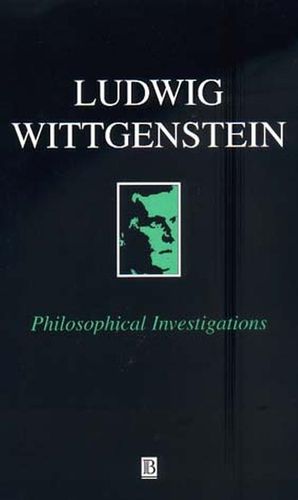
 Ludwig Wittgenstein (1889 – 1951) is my favorite of the latest, greatest philosophers, and I learned his work from Hans Sluga and Barry Stroud at Berkeley, who taught me that Wittgenstein’s later thought experiments can lead to much more than he or we have worked out about truth and meaning. Wittgenstein’s thinking can answer many questions about thinking, not completely but more fruitfully, as Wittgenstein says, than other thinkers can.
 The turn between Wittgenstein’s earlier and later thought is much like the Indian metaphor of turtles supporting the world and the question that arises from such an arrangement. Locke, Hume, Russell and other European philosophers have brought up the Indian debate about what the world sits on such that it is stable and continues. Some say that it sits on a turtle, an animal that symbolizes the cosmos in India and China, as it is flat on the bottom like the earth, and round on the top like the sky. Others ask what the turtle sits on if the world sits on it, and someone once said it’s turtles all the way down. Some have called this an infinite regress, an endless series that vanishes over the horizon, Buddha called it an unsolvable problem, Plato called it the greatest difficulty for philosophy, and today some call it the foundationalism debate, arguing whether or not knowledge or certainty sit on anything known or certain.
 Philosophy is the love and study of wisdom, truth, meaning and thought. Thought interweaves several elements in our world. We sense, see, hear, touch, smell and taste things in our world. We also feel, feeling good, bad, tense and calm about the things we sense. We also remember, sense and feel things that are not in our world, but were. We also reason, building what we remember from sense and feeling into thoughts. In the middle of all this are words, things we hear and see from others that are interwoven with what we sense, feel, remember, and think.
 Is sensing a thing without words, feelings or memories a thought? Is looking at an apple thinking? Is looking at it and feeling a feeling thinking? If I look at an apple and feel happy, is that a thought without words or images in mind? Some say yes, and others say no. Once we have several things interwoven, including the words we use to mean things, many call that thought. Some say thought is logical and rational, such that it follows rules, or follows rules when it is right and correct in judgement. Others say that this is the turtle problem yet again.
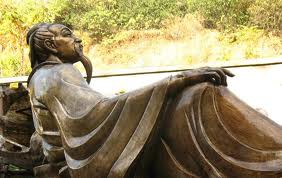 If things need thoughts to make sense of them, and if thoughts need thoughts, such as rules, or plans to make sense of them, is there thought that makes logical, self-aware, rational sense of thought itself? Are there words that make sense out of how we use words to mean things and know things? Some say yes, and it terminates in the rules and forms of logic, and others say no, and we simply continue to gather and divide things without an underlying logic that brings all of our wants and plans into common, coherent systems, visions or words. As Zhuangzi the Daoist asks, What do our ways or words rely on such that our words mean things?
 What do turtles sit on? Some say other turtles. The Buddha in India and Wittgenstein in Britain answered the question with similar, simple metaphors that show us more than any system or logic in images or words can completely in itself. Thought and our world are interwoven, such that it isn’t turtles all the way down, but turtles all the way around. Much as Nicholas of Cusa and Hegel said about a circle, it is an infinite regress, but it is also complete in itself, and continues right in front of us. It isn’t that truth or rules rely or rest on any specific thing, but rather situations of sense, feeling, memory, reason and words mean things all together.
 Situations shift, and these shifts show us how things mean things to us better than any specific words can. As Wittgenstein said, there is what can be said, but what can be said is only a part of what can be shown, which is best done not with complete, enclosed systems of words or images but by leading people through many open-ended situations of mind, stagings of thought, what Wittgenstein called thought experiments that involve many and any elements.
 Much as Alice is frustrated with her sister’s text without pictures in the opening of Wonderland, words and rules without many interrelated examples of rich situations and the infinite variety found in them confuse us and lead us into considering words outside of actual, useful meaning. Carroll wrestled with Boole’s algebra much as Wittgenstein wrestled with Frege’s logic, and both came to the conclusion that words and systems can trap us like a fly in a bottle.
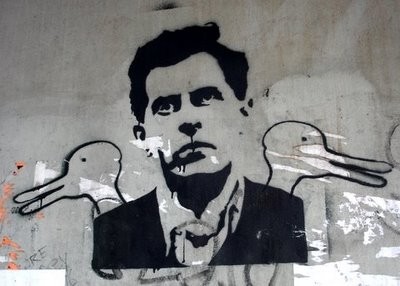 As Zhuangzi said, once we have the rabbit, we can forget the trap, and then we can involve the trap or not as we like, such that we can have words with others who have forgotten words, remembering and forgetting words and understandings freely as we please rather than sitting on particular words or systems as final, fixed foundations. Wittgenstein enjoyed reading Alice’s adventures to two sisters in Wales where he worked on his final thoughts, and he likely heard and felt Carroll’s deeper meaning, that it is good to use thought, rules and logic to show others how open-ended thought can be, beyond anyone’s particular logic, words, thought or feelings.
 Buddha called the interweaving of everything codependent-arising, life as a tangle of many forms of life, as we see in Klimt’s painting Death and Life, which he began in Vienna 1908 and finished in 1915, the time Wittgenstein left Vienna to study logic, mathematics and philosophy with Russell at Cambridge. Klimt was not only one of the most influential painters of Wittgenstein’s Vienna, he painted a portrait of Wittgenstein’s sister, who was also psycho-analyzed by Sigmund Freud. As we might suspect, Wittgenstein’s family had some pull in Vienna, which in Klimt’s day was the city with the latest, greatest culture, replaced in the 1920s by Paris, the 40s by New York and the 60s by San Francisco. Wittgenstein said that life and thought are like an old city, with many forms of life inter-tangled for centuries.
 Much as Buddha taught there is no essence or nature that completely defines or causes a thing because it arises out of the relationships it shares with other things outside of itself, Wittgenstein argued that life is like a thread without a single strand running through the entire length, and so we should always beware of the lure of the secret cellar, the proud idea that we have hit bedrock and completely revealed the truth rather than revealed yet another strong connection between different interwoven things. The cure for this proud ignorance, what Heraclitus called the human disease, is a rich variety of interwoven examples and elements that continue to show us more and more about the greater whole, endlessly.






















 Thought Itself